Benefits
Events
Products & Programs



Author:
Elizabeth Favreau
Marketing Writing Team Lead
It’s hard to beat the thrill of a NASCAR race. The roaring of engines as cars careen around the track as mere blurs, the deafening cheers of the fans, the animated voices of the announcers booming over the din. The atmosphere is electric, and excitement is palpable in the air as cars flash across the finish line.
Guided by the deft hands of the drivers, the race cars are propelled by powerful engines to mindboggling speeds—exceeding 200 mph on some tracks. The engine is the heart of the car, and it can easily make or break a race. Even minor tweaks to the engine can provide the small boost of power needed to best the competition.
Figuring out what tweaks to make, however, is not always easy. Exploring many different designs can be expensive, not just in terms of money, but also time—and time is a highly valued commodity in the racing world. With dozens of races each season, and each one in need of a specialized engine, being able to efficiently assess different design options is key.
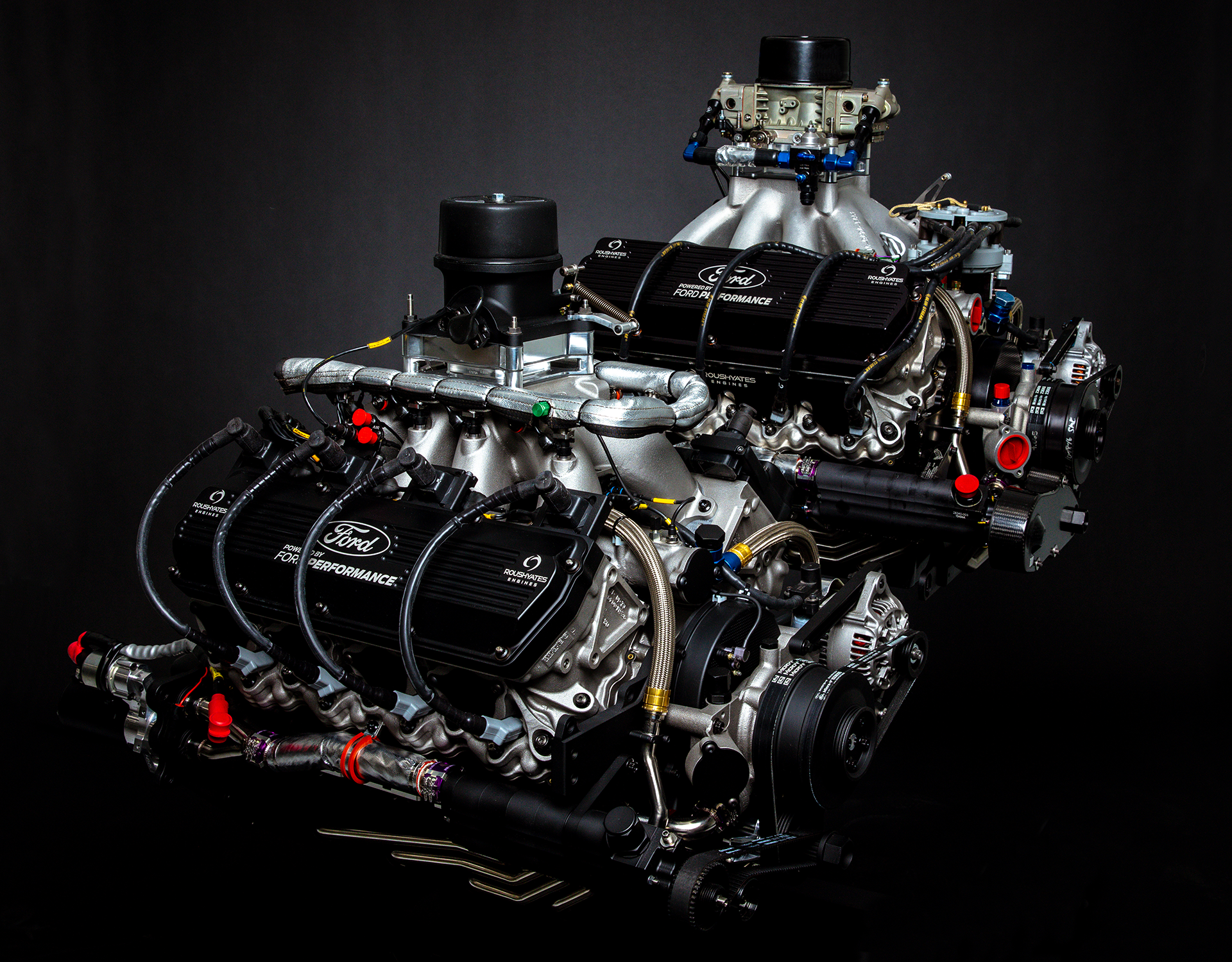
Roush Yates Engines designs, tests, and builds purpose-built race engines for the NASCAR Cup Series and the NASCAR Xfinity Series. Founded in 2004 and headquartered in North Carolina, Roush Yates is the exclusive engine builder to Ford Performance. With nearly 400 wins across the two NASCAR series, Roush Yates is regularly powering cars to victory and championships. So how do they do it? In addition to state-of-the-art test facilities and a team of brilliant engineers and technicians, incorporating advanced modeling software like CONVERGE into their design process is one of their key strategies for winning.
Designing racing engines is obviously a different beast than designing engines for everyday passenger vehicles. Each engine must be tailored to the specific tracks where it will be raced, with the goal of eking out every bit of performance possible. To achieve this, you need to consider a variety of factors, including the length of the track (typically ranging from 1/2 mile to over 2 miles), the vehicle traction available, differences in driver style, climate conditions, and even elevation.
“It’s very interesting to design for those types of different environments to make sure we’re doing the most we can to bring the best engine we can to each track,” says Jamie McNaughton, Technical Director at Roush Yates Engines.
Power isn’t the only necessity in a racing engine, either; the engines also need to be durable. While these engines won’t be racking up hundreds of thousands of miles, they need to be at peak performance while being driven under extreme conditions for up to three races and numerous practice sessions, which can add up to some 1,500 miles. All the power in the world won’t help you win if your engine breaks down mid-race!
So, you need performance, reliability, and durability. No pressure, right? Now add in the fact that you’re also working on a very short timeline. While the design cycle for a passenger vehicle engine might be on order of three years, in the NASCAR world, you’re working with timelines as short as 8-12 months. And there’s a lot that needs to be packed into those months, from planning and analysis to testing and production—any tools that can help speed up your design process can be a major advantage.
So how does Roush Yates leverage CFD in their engine design process?
Per the rules of NASCAR racing, manufacturers are working with homologated parts, i.e., parts that have been officially approved by the organization. Manufacturers can tweak these parts, but they can’t go off and make something brand new. That means that Roush Yates’ engineers are working within well-defined boundaries to try to find minor modifications that result in small but meaningful gains in power and performance.
This is where CFD shines. “Finding the last 0.5% that we’re looking for requires comprehensive 3D modeling,” says Jamie.
Roush Yates uses CONVERGE to model a variety of powertrain components, including intake manifolds, cylinder head ports, exhaust systems, intake systems, and cooling systems. To improve the engine’s gas exchange process, they use CONVERGE to analyze intake manifold flow losses, tune the manifold, and model the exhaust systems. Furthermore, they conduct cooling system evaluations to ensure that the coolant flow rate and system pressure are correct for the engine specifications and the tracks being raced.
“We’ve found CONVERGE’s combustion modeling and meshing technique to be very advantageous for complex geometries and transient simulations,” says Jamie. “Our main goal at Roush Yates is to have the highest power, efficiency, and the most reliable engines in NASCAR. Working toward these goals, we have continuously improved in all these areas throughout the race season with the help of CONVERGE.”
CFD also helps Roush Yates accelerate their development efforts to meet the rapid design cycles required by the sport. The power of simulation lies in the ability to test many different design iterations before manufacturing any components. Compared to physical prototyping, CFD simulations are relatively fast and cheap, and virtually modifying the designs of the components can be done in a matter of clicks.
CONVERGE’s autonomous meshing makes it fast and simple to set up many different cases, because you don’t need to manually create any meshes. This allows you to analyze dozens or even hundreds of design options to determine which ones are the most promising. Only needing to build and test a much smaller number of components leads to a faster time to the track. Moreover, being able to explore so many designs allows you to find those small increases in performance that can end up providing a big advantage on the track.
“CONVERGE enables rapid setup of simulation models, and it has a fast learning curve—new analysts can be brought up to speed on CONVERGE in a matter of weeks,” says Jamie. “Additionally, the more recent versions of CONVERGE have runtimes that scale very well on CPUs. The values of speed and simplicity are some of the most essential capabilities for a CFD tool in the motorsport industry.”
For Roush Yates, their advanced design techniques clearly pay off. Boasting 12 NASCAR Cup Series championships, 17 NASCAR Xfinity Series championships, and hundreds of wins and poles across the two series, Roush Yates is at the top of the game in the motorsport industry. They employ more than 100 people in their engine shop, doing everything from design, simulation, building, and testing, in order to compete on an international stage in upward of 70 events each year.
As Jamie says, “It’s the kind of situation where if you have a job you really love, it’s not so much work as having a great time, continuing to learn and build a great team to achieve our goals.”
No one can say how the next race will unfold, but one thing’s for sure—we’ll continue to cheer on our partners at Roush Yates and do our best to support them on their NASCAR journey.
Learn more about Roush Yates’ engine design process at our upcoming webinar, The Power of CONVERGE for Race Engine Development at Roush Yates Engines, presented by Jamie on September 10 at 10:30am CDT! Register here.


