

Gas Turbines
Postdictive to Predictive
Gas turbine combustion is a complex process, and it can be a challenge to achieve accurate and reliable CFD simulation results at a reasonable computational cost. Modeling gas turbine combustion requires appropriate mesh resolution that captures all important physical phenomena, as well as detailed turbulence, spray, and emissions models. To achieve the necessary level of efficiency, most CFD solvers are postdictive, that is, they rely on simplified combustion models that are only accurate after extensive tuning of critical model parameters.
By contrast, CONVERGE’s powerful tools provide the accuracy needed for predictive simulations. For example, while other CFD solvers may simplify chemical reaction calculations by using empirically tuned variables, CONVERGE solves the chemical kinetics directly within the simulation. These advanced methods allow for a more accurate prediction of the combustion process and the intricate interactions within the turbine, helping engineers make informed decisions about the design and operation of gas turbines.
Ignition
CONVERGE models ignition and flame propagation with an accurate representation of the spark energy, volume, and duration, as well as flame kernel formation and propagation. These models are essential for predicting combustion behavior in engines and industrial applications.
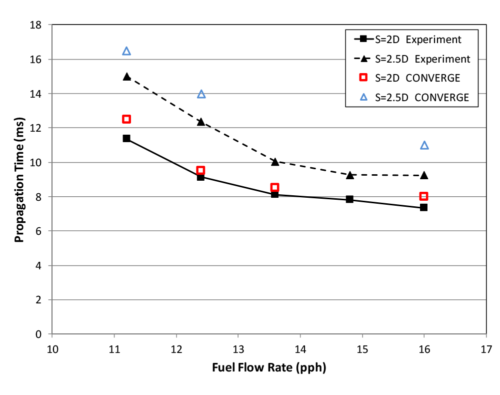
CONVERGE simulation of gas turbine relight in a five-burner configuration of the University of Cincinnati burner. Modeling relight, the process of re-igniting a previously extinguished flame, requires accurate modeling of the flame, the residual fuel vapor, and re-ignition sources.
To enhance precise simulation of ignition and flame behavior, CONVERGE uses detailed fuel chemistry mechanisms provided by the Computational Chemistry Consortium (C3). C3 gives users access to C3Mech, a comprehensive mechanism that contains accurate chemistry for a wide range of fuels, including alternative fuels such as hydrogen, natural gas, and biodiesel. With the extraction tool in CONVERGE Studio, you can extract the necessary sub-mechanism for your simulation. The mechanism reduction and tune tools can help you simplify the detailed fuel mechanism to an accurate and concise mechanism that can be used in CFD simulations.
Lean Blow-Off
Lean blow-off (LBO) is a critical performance factor for lean premixed systems in the energy and transportation industries. LBO refers to a phenomenon in which the flame is extinguished due to a lean fuel-air mixture, leading to a loss of power or engine shutdown. Simulating LBO behavior in a combustor is key to improving safety and combustion stability. Accurate LBO modeling requires moving beyond simplified or tabular combustion methods, which can reduce chemical accuracy during non-equilibrium events. With CONVERGE’s detailed chemistry solver, you can use a mechanism containing the low-temperature ignition reactions that are characteristic of LBO phenomena.
The video below shows a simulation of LBO for both A-2 and C-1 fuel in a representative gas turbine combustor. CONVERGE’s autonomous meshing, detailed chemistry, and large eddy simulation (LES) turbulence modeling were used to predict the blow-off behavior.
CONVERGE simulation of lean blow-off predictions for Jet-A and alternative jet fuel.
Flame Flashback
A successful gas turbine design must be able to handle flame flashback, a phenomenon where the flame propagates upstream, potentially causing damage to fuel pipes, fuel tanks, or other critical components. Flame flashback can occur due to high turbulence, autoignition, high flame speeds, or preignition of a separated flow region.1
CONVERGE’s LES modeling can accurately capture transient flow during flame flashback. The detailed chemistry solver can handle the complex interplay of chemistry and fluid dynamics, while adaptive zoning speeds up the calculations. Adaptive Mesh Refinement (AMR) can selectively refine the mesh to resolve regions where there are high gradients in velocity, temperature, or species.
CONVERGE simulation of flame flashback in a premixed hydrogen/methane-fueled swirl burner. Swirl burners are commonly used in gas turbines because of their flame stability and rapid fuel-air mixing.
CONVERGE can also help prevent flashback by enabling engineers to find the optimal placement of a flame arrestor in the intake manifold, such that it quenches the flame and stops it from spreading. This is especially useful for hydrogen fuel, whose faster mixing rates and higher flamespeeds make it more prone to flashback. CONVERGE includes several unique features that make it well-suited for designing flame arrestors for gas turbines. Typically, flame arrestors will consist of many narrow channels, which can be easily captured by our autonomous meshing. The flow, combustion, and wall heat transfer within these channels can be simulated with CONVERGE’s turbulence modeling, detailed chemistry solver, and conjugate heat transfer (CHT) modeling capabilities. If the walls of the arrestor become too hot from repeated backfiring, which can be caused by ignition issues such as incomplete mixing or incorrect ignition timing, the flame arrestor will no longer be able to arrest the flame. CHT modeling can predict how the metal walls gain and lose heat during interactions with intake flow and backfire flames over various engine cycles to address these cases.
Thermoacoustic Modeling
Combustion instabilities, also known as thermoacoustic instabilities, often arise from the non-linear interactions between acoustic fluctuations and the unsteady heat release during combustion. These phenomena occur within propulsion systems such as ramjets, scramjets, rocket engines, afterburners, and gas turbines. Unchecked, these instabilities can cause increased thermomechanical stress, greater vibration levels, thrust variations, flame flashback, or LBO. CFD can provide insights into how temperature fluctuations and pressure oscillations develop, helping to design turbine combustors that minimize these instabilities.
CONVERGE’s LES with fine meshing and small time-steps can effectively resolve the complex interactions between fluid dynamics, combustion, and acoustic fields. Furthermore, non-reflective boundary conditions (NSCBC) are important for preventing unphysical flame-acoustic interaction. CONVERGE’s density-based solver easily resolves other acoustic phenomena, and the SAGE detailed chemistry solver handles the complex chemistry in these simulations.
Liquid Fuel Simulation
Liquid fuel simulations of aviation and power gas turbines are simple and robust thanks to a wide variety of spray modeling options in CONVERGE. Injected sprays can be defined by drop size, size distribution, spray velocity, or cone angle. Regardless of size, speed, or volume, sprays can undergo different physical processes that occur on very small length scales. CONVERGE includes a number of sub-grid models for simulating liquid atomization, drop breakup, collision and coalescence, turbulent dispersion, drop evaporation, boiling, and flash boiling. With these models, CONVERGE is well equipped to accurately capture the fuel-air mixing in gas turbine engines.
Lagrangian approaches for sprays track individual particles as they move through a flow field, measuring their trajectories separately and accounting for forces such as gravity and drag. Because this framework treats the flow field as compact parcels of mass, it is highly suitable for most spray simulations, where the spray initiates, propagates, and dissipates quickly on a small spatial scale. CONVERGE also includes powerful Eulerian modeling techniques to capture multi-phase flows through a volume of fluid (VOF) approach. By tracking the volume of fluid within each cell, the Eulerian approach treats the phases in a simulation as a continuum.
In some cases, neither Lagrangian nor Eulerian modeling alone can fully capture the spray behavior; coupled approaches combine the benefits of both methods to optimize the simulation for certain applications. The VOF-spray one-way coupling technique is useful for setting up the initial conditions in a simulation, but this approach is unidirectional; once the system has progressed from Eulerian to Lagrangian modeling, the simulation must be completed through Lagrangian methods. By contrast, the Eulerian-Lagrangian Spray Atomization (ELSA) method is a fully coupled approach, where both Eulerian and Lagrangian modeling are completed in the same simulation.
CONVERGE video of a spray jet in crossflow as the simulation transitions from Eulerian VOF modeling to Lagrangian parcels.
CONVERGE’s autonomous meshing enables the creation of a high-quality grid; adding AMR ensures the grid will automatically adjust as the spray moves. This technology delivers the precise resolution you need, exactly where and when you need it—in these cases, near the injector and along the path of the spray. By combining autonomous meshing, AMR, and advanced spray models, CONVERGE offers a unique advantage in achieving grid-convergent results efficiently.
Emissions Prediction
The emission of pollutants such as NOx, CO, unburnt hydrocarbons (UHCs), and soot (particulate matter) is a critical design consideration for gas turbines. CONVERGE includes several methods for predicting emissions from combustion.
You can predict NOx and CO emissions with CONVERGE’s SAGE detailed chemistry solver. SAGE will directly calculate the pollutant species as NO, NO2, UHC, or CO using an accurate fuel mechanism. Because this approach relies on modern fuel mechanisms, it includes reburn kinetics and NOx sensitization, which can be important for rich-burn, quick-mix, lean-burn (RQL) systems.
CONVERGE also includes the fast Flamelet Generated Manifold (FGM) combustion model, which can be used with the extended Zel’dovich thermal NOx mechanism to calculate passive NOx formation. Fuel-rich and low-temperature conditions may induce the transient formation of NOx, which can be modeled through a simplified prompt NOx mechanism. Another NOx emissions model is the fuel NOx model, which can predict emissions from nitrogenated fuels, such as NH3 or HCN.
Soot modeling for gas turbines is critical for combustor design as particulate matter emissions regulations become more expansive. CONVERGE allows you to explore new strategies for soot mitigation with its comprehensive set of state-of-the-art features. The traditional Hiroyasu empirical model is a two-step approach where soot is formed from a single precursor (usually acetylene) in one step and oxidation is modeled in the second step. Phenomenological approaches, including the Gokul, Dalian, and Waseda models, further consider the inception, surface growth, coagulation, and oxidation steps.
CONVERGE also offers detailed soot models like the Particulate Mimic (PM), Particulate Size Mimic (PSM), and Sectional Soot (SSM) models, which focus on the role of polycyclic aromatic hydrocarbons (PAHs) in soot formation. These models are more computationally expensive but perform well over a wider range of operating conditions. The PM model provides the average soot particle size and number density based on the method of moments. The PSM model provides information on the particle size distribution. SSM separates soot particles based on mass, enabling the calculation of the soot number density function (SNDF) at each time-step, which can help you understand how soot evolves over time and enhance predictions of pollutant formation.
Mesh Generation
CONVERGE’s autonomous meshing automatically generates a perfectly orthogonal grid at runtime using a Cartesian cut-cell approach. Autonomous meshing can create an accurate grid even for small, complex parts of your gas turbine geometry, such as passages through swirlers and effusion cooling holes. This feature helps you spend less time on setting up your simulation and more time on engineering to design optimal combustors.
AMR increases the mesh resolution when and where it is needed throughout a simulation. CONVERGE will optimize the cell count to maximize accuracy and computational efficiency by automatically adjusting the grid at each time-step, adding cells in areas with complex phenomena and eliminating superfluous cells.
From CAD to CFD
CAD models are the foundation of any simulation workflow, and these files serve as the starting point for preparing your geometry for CFD analysis.
To begin your simulation, you can import native CAD files into CONVERGE Studio, where they will be automatically triangulated. Alternatively, the CAD Editor allows CFD engineers to make geometry modifications directly on the CAD surface before creating a high-quality triangulation. This tool helps bridge the gap between CAD designers, who may be less familiar with CFD, and CONVERGE engineers, who know how to optimize the CAD geometry specifically for CFD simulations.
CONVERGE Studio also includes tools for repairing problems in a geometry and performing simple manipulations, such as rotating, scaling, or merging. An additional Polygonica license gives you access to advanced geometry manipulation tools, allowing you to perform Coarsen, Boolean, and Healing operations. Furthermore, the surface wrapper option can create watertight models to efficiently fill holes in dirty geometries.
Thermal Management
As the Law of Energy Conservation states that energy is neither created nor destroyed, heat energy is constantly transferred between the solid components and surrounding fluids in a system, changing the temperatures of both domains. CONVERGE supports fast and accurate predictions of combustor wall temperatures with CHT modeling, which captures temperature distribution, cooling flows, and thermal coupling.
CONVERGE offers several methods to increase the efficiency of CHT simulations. Typically, heat transfer in the solid region occurs more slowly than in the fluid domain. The difference in time scales can be problematic for CFD engineers because it leads to long simulation runtimes. CONVERGE’s super-cycling feature freezes the faster fluid solver to allow the solid solver to progress to steady state, enabling you to solve the heat transfer in both domains without consuming unnecessary time or computational resources.
The fixed flow method is another acceleration technique that can be useful for CHT simulations with both transient and steady-state streams; with this method, one stream is frozen in a cyclic manner while the other progresses smoothly.
Microturbines
Microturbines are small, high-efficiency turbines used for both stationary power generation and the propulsion of small aircrafts like drones, unmanned aerial vehicles (UAVs), or hobby airplanes. They are important for decentralized power generation, offering a reliable energy solution for remote areas or distributed energy systems. Their compact size, low emissions, and fuel versatility make them a valuable tool for both backup power and sustainable energy applications.
CONVERGE’s innovative set of features, from the SAGE detailed chemistry solver to AMR, significantly boost the accuracy of microturbine simulations. Chemistry calculations can often be computationally expensive, which is mitigated by CONVERGE’s adaptive zoning feature. Adaptive zoning groups computational cells by thermodynamic state and invokes the chemistry solver for each group instead of each cell. This multi-dimensional zoning strategy ensures faster simulations without compromising on accuracy.
CONVERGE simulation of the combustion process in a hydrogen-fueled microturbine, captured with the SAGE detailed chemistry solver and large eddy simulations (LES).
Microturbine geometries are notoriously complex, and their many moving parts are often difficult to capture accurately. CONVERGE’s AMR, which refines or coarsens the grid as the simulation progresses, as well as the fixed embedding feature, which increases mesh density at user-specified locations, are instrumental in capturing the detailed flow fields in microturbine geometries.
Rotating Detonation Engines
A rotating detonation engine (RDE) is a compact and efficient device for generating thrust in a variety of propulsion and defense applications. These mechanically simple engines have no moving parts, making them less complex and therefore less costly to manufacture and maintain than traditional gas turbine engines. In theory, RDEs could increase both range and speed for missile and aircraft applications, with a reduced fuel penalty.
RDEs generate thrust via a supersonically traveling detonation wave, which can offer a substantial increase in efficiency with a decrease in emissions. While traditional gas turbine engines operate on deflagrative combustion (i.e., occurring at subsonic speeds), RDEs leverage detonative combustion, (i.e., explosions). In an RDE, the shockwave travels around a circular channel within the engine. The fuel and oxidizer are added periodically through small holes in the channel, where they are immediately ignited by the circling detonation wave, producing continuous thrust.
CONVERGE is a powerful CFD tool that offers numerous benefits for RDE simulations. One of CONVERGE’s main advantages is its AMR feature, which adapts the mesh as your simulation is running, giving you higher resolution when necessary. AMR can help capture the flame structure and the shockwave, two critical phenomena in RDEs. CONVERGE’s SAGE detailed chemistry solver uses chemical kinetic mechanisms to model a variety of fuel and oxidizer combinations. Based on detailed chemical kinetics, SAGE can provide highly accurate predictions of fuel mixing and combustion within the engine. Other capabilities of CONVERGE, including the real-fluid, soot and emissions, spray and atomization, radiation, and simplified combustion models, can also be leveraged in developing robust and accurate simulations for these complicated systems.
References
[1] Keller, J.O., et al. “Mechanism of Instabilities in Turbulent Combustion Leading to Flashback.” AIAA Journal, 20(2), 1982, 254–262. https://doi.org/10.2514/3.51073


