
Benefits













Eulerian Multi-Phase
Fundamentals of Multi-Phase Flow Simulations
Multi-phase flows are nearly ubiquitous in engineering applications, and understanding them is critical to the design and development of everything from internal nozzle flow in fuel injectors to the transport of oil and gas in pipelines. However, numerically modeling multi-phase flows can be challenging, due to the wide disparity in densities between different phases, complex fluid-structure interaction, and more. CONVERGE is a leading CFD tool that offers powerful techniques to capture multi-phase flow, including Lagrangian methods, Eulerian modeling, and coupled techniques. This page will discuss CONVERGE's Eulerian modeling capabilities; for information on CONVERGE's Lagrangian techniques, we encourage you to check out our Injectors & Sprays page.
Eulerian Modeling
CONVERGE's Eulerian approach treats all phases as a continuum. This method naturally locates and tracks the free surface in a liquid-gas flow or the interface in a liquid-liquid flow. It can be used for both compressible and incompressible fluids. Eulerian models are especially useful in liquid cooling for emobility systems, multi-phase flow with high particle concentrations (such as fluidized beds or bubbly flows), and environmental flows.
Volume of Fluid (VOF) Modeling
CONVERGE's volume of fluid (VOF) method is an Eulerian approach for multi-phase flows that tracks the volume of fluid in each cell. VOF modeling requires a solution method to discern the order in which the physical equations will be solved. The void fraction solution (VFS) method solves the transport equation for the void fraction, in addition to the mass, momentum, and energy conservation equations. Since the void fraction is a single scalar quantity, VFS can only be applied to simulations of incompressible two-phase flows. Another option is the individual species solution (ISS) method, which transports each individual species in the momentum and energy conservation equations. This extends the simulation capability to multi-phase flows with any number of species and phases. When running ISS for compressible fluids, you may use either the species density solver or the species mass fraction solver. However, when running the ISS for incompressible fluids or simulations with more than one liquid species, you must use the species density solver. By conserving mass and energy, this solution method enables CONVERGE to simulate multi-phase combustion problems, such as pool fire simulations.
Multi-Fluid Multi-Field Model
CONVERGE also offers the Multi-Fluid Multi-Field (MFMF) model, which uses the base Eulerian framework but additionally considers local non-equilibrium effects that are caused by the varying inertia values for different phases or species. MFMF will separately solve the continuity, momentum, and energy equations for each species/phase, which causes the interface to form naturally due to the different velocities. This method is able to predict more realistic flow fields for simulations including bubbly, slurry, droplet- or particle-laden flows, pneumatic transport, sudden acceleration, and mixture separation in a gravitational or rotational field.
Particle stress, which refers to the internal forces that neighboring particles in a fluid exert on each other, plays an important role in modeling granular flows such as fluid-solid, gas-droplet, and bubbly flows. With an MFMF simulation, you can activate particle stress modeling to account for the two sources of stress on dispersed particles: collisions and friction between particles.
To use the MFMF model to simulate gas-liquid flows through porous media, you must account for the different permeabilities of the gas and liquid phases, in addition to the capillary effects that occur at the interface inside the porous structure. These effects can be incorporated by using the porous media implementation for the MFMF model.
Coupled Approaches
CONVERGE includes two options that combine the benefits of Eulerian and Lagrangian methods to optimize the simulation for certain applications. While both VOF-spray one-way coupling and Eulerian-Lagrangian Spray Atomization transition from Eulerian modeling to Lagrangian modeling, there are unique characteristics to the two methods that would substantiate their application.
VOF-Spray One-Way Coupling
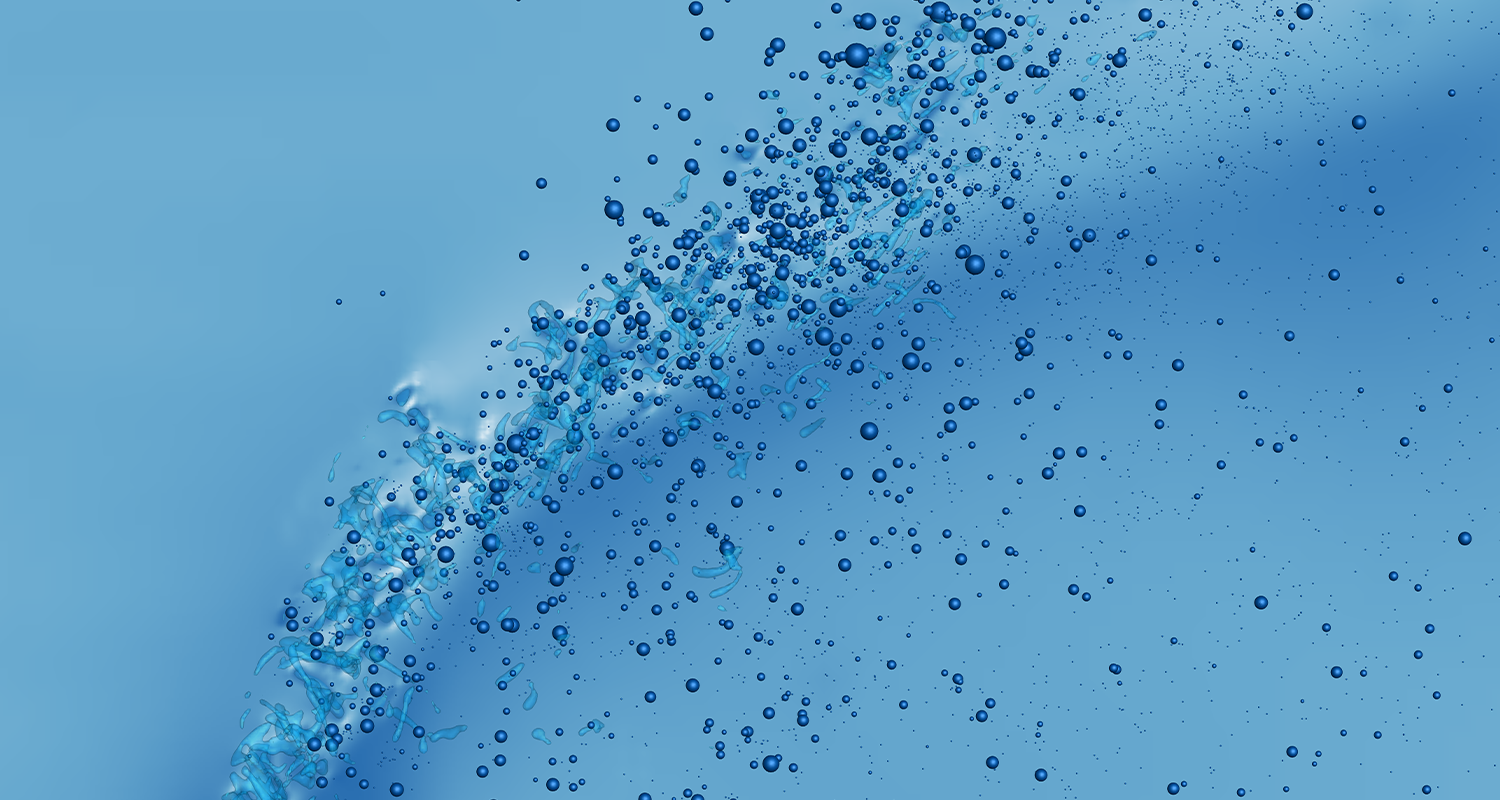
In this approach, an Eulerian VOF approach is used for initial case setup and the calculation of detailed boundary conditions. These conditions are then used to initialize parcels for a separate Lagrangian spray simulation. Through this coupling, the Lagrangian simulation does not need to solve for the initial conditions, which reduces overall runtime. CONVERGE users can employ VOF-spray one-way coupling for applications such as reproducing hole-to-hole variation in multi-hole injectors. While VOF-spray one-way coupling is useful for setting up the initial conditions in a simulation, the "one-way" technique indicates unidirectional coupling; once the system has progressed from Eulerian to Lagrangian modeling, the simulation must be completed through the Lagrangian technique.
Eulerian-Lagrangian Spray Atomization
The Eulerian-Lagrangian Spray Atomization (ELSA) method is a truly coupled approach, where both Eulerian and Lagrangian modeling are completed in the same simulation. The ELSA method tracks the density of the injected liquid as it enters the combustion chamber and solves for liquid surface area density. The solver will use this value to determine the size of the droplets formed when the fluid is converted into Lagrangian parcels. The transition is controlled by the gas volume fraction and fluid surface area in a cell. If both transition criteria are satisfied, the liquid mass in that cell is converted to parcels. This approach is very useful for a variety of atomization applications, such as fuel injectors, shower heads, water splashes, and more.
Maintaining a Sharp Interface
In CONVERGE, multi-phase simulations can benefit from an appropriate front interface capturing scheme that generates precise information about the shape or location of an interface for detailed flow solutions. CONVERGE includes three different front capturing schemes: Piecewise Linear Interface Capturing (PLIC), flux-corrected transport (FCT), and High Resolution Interface Capturing (HRIC).
PLIC is a geometry-based interface capturing scheme that is only available for simulations that employ the VFS method. PLIC constructs the phase interface by separating the fluids geometrically and using a planar shape in each cell. After constructing the surface, PLIC will translate the interface according to the local fluid velocity. Although this method can maintain a sharper interface than HRIC and FCT, it cannot fulfill conservation laws as well as the other methods and is limited to incompressible two-phase flows.
On the other hand, both the HRIC and FCT schemes can be used with compressible and incompressible fluids and are available for simulations employing the ISS method or the MFMF model. HRIC enables the solver to avoid artificial effects such as diffusion, dispersion, or local oscillations of the void fraction. The FCT scheme limits diffusive and dispersive numerical errors by constructing a net convective flux as a weighted average of the flux computed through a lower-order scheme and a higher-order scheme. In multi-phase flow simulations, this is especially useful when solving the species density equations. Both the HRIC and FCT schemes create sharp phase interfaces while limiting numerical effects.
Drift Flux Model
CONVERGE's drift flux model accounts for multi-phase flows where different species in a mixture move at different velocities due to gravitational or inertial effects. This model is available for multi-phase flow simulations that use the ISS method with the species density solver. To account for the differences in velocity, the model will add source terms to the transport equations for each species. The model also assumes a drift velocity for each species, which is relative to the mixture velocity. For liquid-gas flows inside porous media, the drift flux model accounts for the capillary effects at the interface, as well as the different permeabilities of the phases. To enhance the accuracy of the model, the drift flux model for porous media considers the drift velocities between gas and liquid phases as additional source terms for the mixture equations.
The default option in CONVERGE will activate the drift flux model for every cell in the computational domain. To optimize computational efficiency, CONVERGE includes the long-scale interface model, which can identify cells where the drift flux model is unnecessary and can be disabled without a notable impact on the accuracy of the overall simulation.
Surface Compression Model
For applications that require a sharp fluid-fluid interface, CONVERGE includes the surface compression model, which reduces numerical diffusion at the interface to sharpen the local gradients of the species volume fractions. Like the drift flux model, the surface compression model is only available for multi-phase flow simulations that use the ISS method with the species density solver. While the drift flux model is designed to capture specific physical phenomena such as mixture separation, the surface compression model is a purely numerical technique designed for sharpening the interface.
Species Sub-Cycling
The Courant-Friedrichs-Lewy (CFL) condition is a dimensionless value related to the distance that physical information travels within the mesh during a single time-step. In other words, the CFL number is directly proportional to the degree of refinement in your mesh.
If your simulation runs at a high CFL number, the tools available in CONVERGE that keep the interface sharp become less effective and you would see the interface becoming progressively more smeared as the CFL number increases. Therefore, you would need a CFL number less than 1 to maintain an adequately sharp interface. The drawback of this constraint, especially in cases with complex interfaces, is the high computational expense.
CONVERGE's species sub-cycling feature allows you to bypass this restriction by solving the species density equation at smaller time-steps as many times as needed for other equations-such as momentum, velocity, pressure, passives, scalars, turbulence, and energy transport-to advance. In simpler terms, other equations will be solved at reasonably high CFL values, whereas the species density and species density transport equation sub-cycles and are solved at low CFL values. This computational approach keeps the simulation efficient while maintaining a sharp interface.
Specialized Models for Additional Phenomena
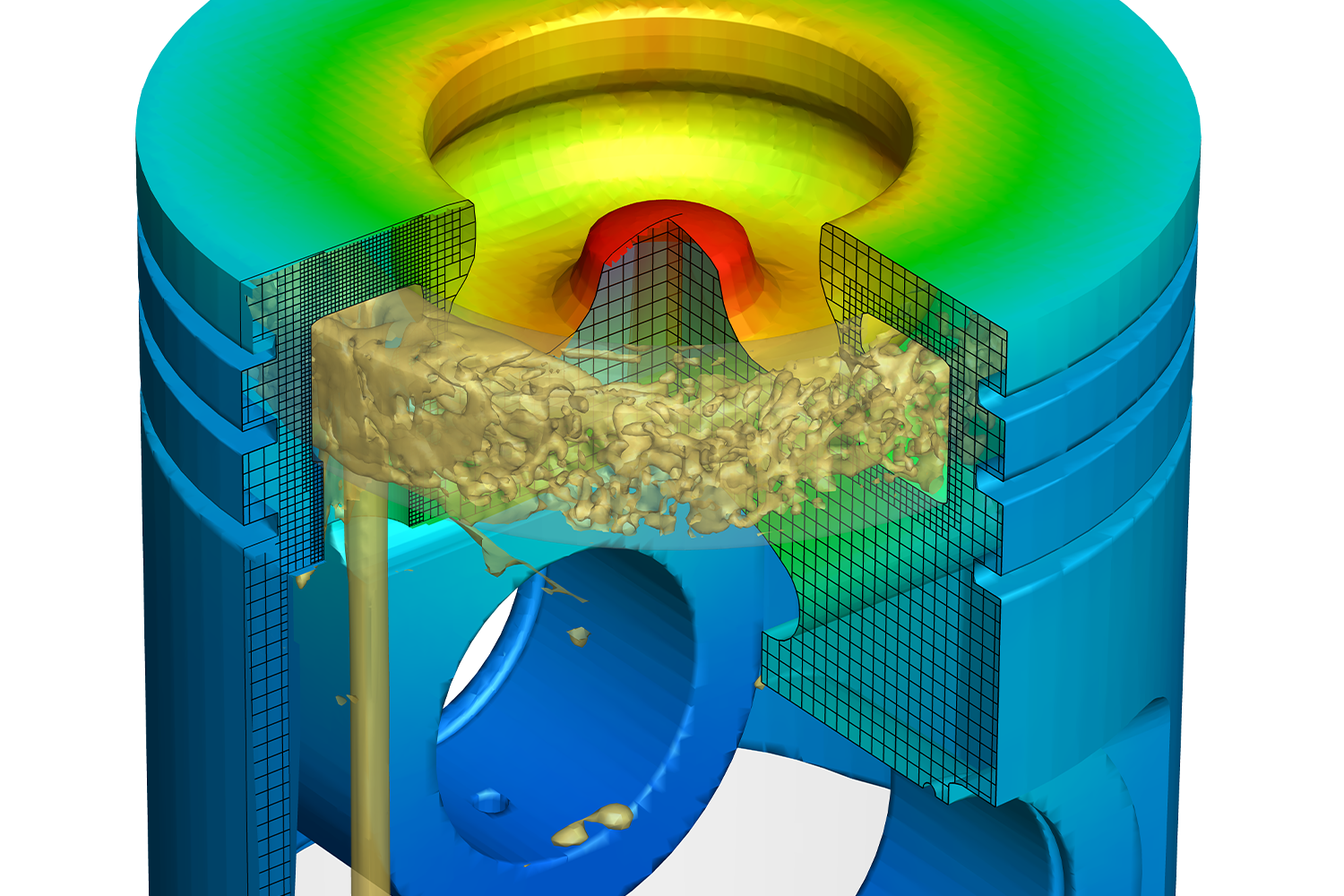
CONVERGE also includes several models that are designed to capture various phenomena in multi-phase flows. Depending on your specific case, you can activate any combination of these models to optimize your simulation.
Surface Tension and Wall Adhesion
Surface tension is the physical phenomenon where a liquid surface acts like a stretched elastic membrane due to the cohesive forces between liquid molecules. CONVERGE models this with a continuum surface force (CSF) model, which alleviates the interface topography constraints. This model treats surface tension as a continuous, three-dimensional effect across an interface, rather than as a boundary value condition. Surface tension between liquid and solid surfaces may further be complicated by wall adhesion effects. To account for these effects, you would need to specify a wall adhesion angle in the surface tension model.
Boiling and Dissolved Gas
The Lee boiling model predicts the mass transfer between the liquid and vapor phases based on the difference between the cell temperature and the saturation temperature. Since this model does not account for evaporating bubbles that are smaller than the grid size, this technique is mostly used for applications where the boiling occurs on a large scale. CONVERGE also offers the RPI wall boiling model, which can be used to describe the subgrid boiling that occurs on superheated walls. In this model, the total heat flux is divided into three parts: the evaporation heat flux, the convective and quench heat fluxes for the liquid phase, and the convective heat flux for the vapor phase. This partition acknowledges the complex interplay between convection, evaporation, and quenching forces to accurately capture the nuances of heat transfer during boiling.
Under certain conditions, a gas may dissolve into a liquid, or it can exit the solution and return to a free gas phase. A dissolved gas model can be set up to model these physical processes in a multi-phase flow simulation. The model may either be species- or passive-based, where the gas in the solution is represented by a liquid or a passive, respectively.
Cavitation Modeling
Cavitation is a representation of the formation of vapor due to a system at constant temperature experiencing a sudden drop in pressure. To model this phenomenon, CONVERGE includes several cavitation models that differ depending on parameters such as temperature.
Homogenous Relaxation Model
The homogenous relaxation model (HRM) is based on flash boiling, in which a liquid fuel is subjected to superheated conditions, causing rapid bulk conversion of the liquid fuel to gaseous vapor. Since the vaporization process in cavitation is very similar to that of flash boiling, HRM has been successfully used by many researchers for modeling cavitation in diesel and gasoline direct-injection sprays.1 This model predicts the mass exchange between the liquid and the vapor and describes the rate at which the liquid-vapor mass interchange approaches its equilibrium value. In both flash boiling and cavitation cases, HRM provides accurate modeling in terms of mass flow rate and discharge coefficients.
Homogenous Mixture Model
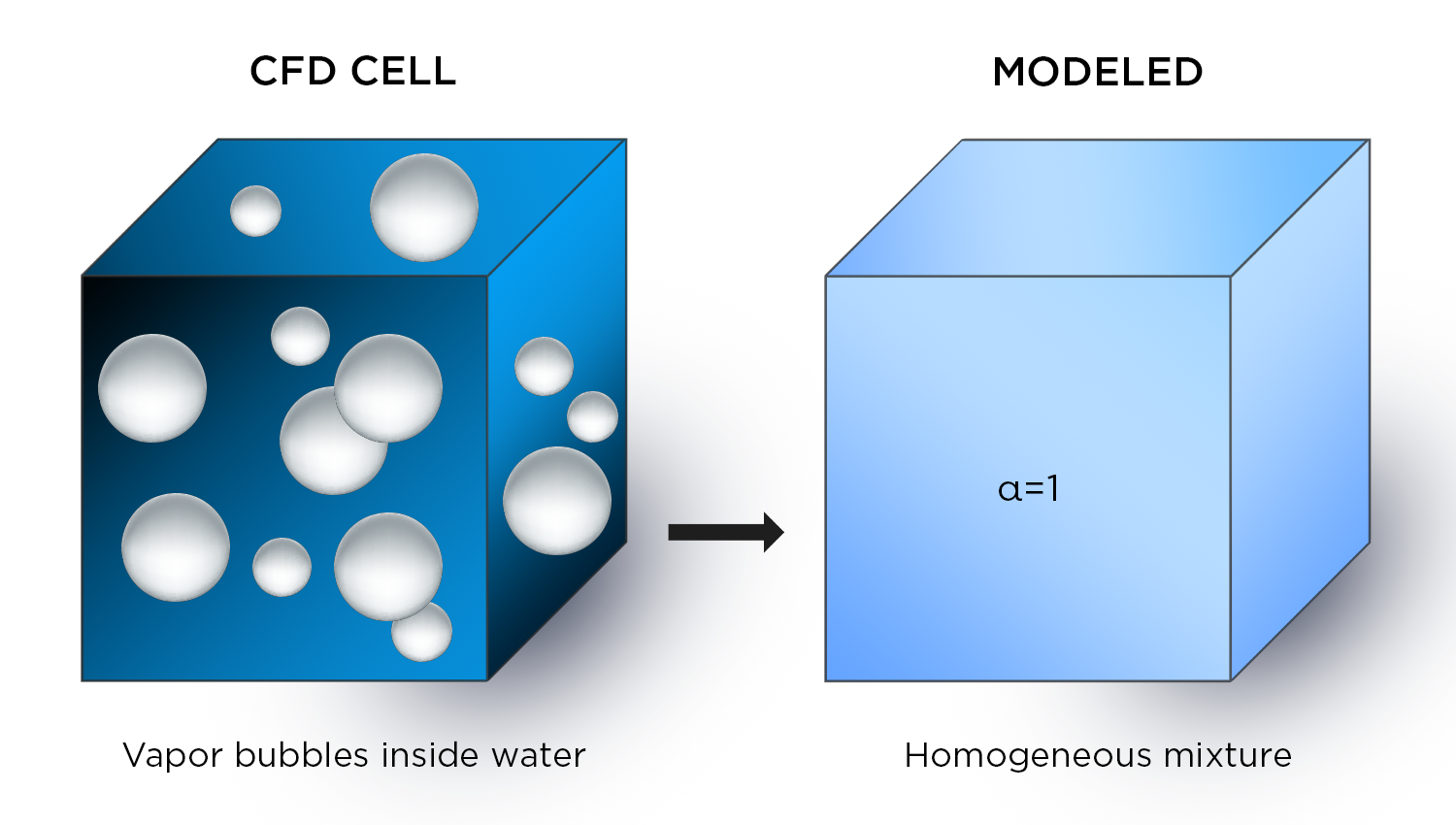
Homogenous mixture models (HMMs) treat the mixture of water, vapor, and non-condensable gases in a cell as a single entity. Instead of solving separate Navier-Stokes equations for each individual phase, a single set of equations is solved for the entire mixture. Their accuracy and efficiency make HMMs highly suitable for simulating large-scale cavitation problems in applications including turbomachinery, marine systems, underwater explosions, industrial pipe flow, and more. Depending on your specific case, you may choose to use the Schnerr and Sauer (SS) model, the Singhal model, or the Saito model.
References
[1] Saha, K., Som, S., and Battistoni, M., "Investigation of Homogenous Relaxation Model Parameters and Their Implications for Gasoline Injectors," Atomization and Sprays, 27(4): 345-365, 2017.
Selected Bibliography
Università degli Studi di Perugia,
Argonne National Laboratory
Battistoni, M., Som, S., and Longman, D.E., "Comparison of Mixture and Multifluid Models for In-Nozzle Cavitation Prediction," Journal of Engineering for Gas Turbines and Power, 136(6), 061506, 2014. DOI: 10.1115/1.4026369
Università degli Studi di Perugia,
Argonne National Laboratory,
Convergent Science
Battistoni, M., Xue, Q., Som, S., and Pomraning, E., "Effect of Off-Axis Needle Motion on Internal Nozzle and Near Exit Flow in a Multi-Hole Diesel Injector," SAE International Journal of Fuels and Lubricants, 7(1), 167-182, 2015. DOI: 10.4271/2014-01-1426
U.S. Military Academy,
U.S. Army Combat Capabilities Development Command Army Research Laboratory
Bravo, L., Kweon, C.-B., Nelson, T., Benson, M., and Van-Poppel, B., "Eulerian Modeling of Hollow Cone Sprays," 22nd ARL/USMA Symposium, Aberdeen, MD, United States, Oct 29-1, 2014.
Università degli Studi di Perugia,
Argonne National Laboratory,
University of Massachusetts
Duke, D., Battistoni, M., Swantek, A., Sovis, N., Kastengren, A., Powell, C., Som, S., and Schmidt, D., "Validation of Cavitation Simulations in Submerged Nozzles," ILASS Americas 27th Annual Conference on Liquid Atomization and Spray System, Raleigh, NC, United States, May 17-20, 2015.
Argonne National Laboratory,
Convergent Science,
Sandia National Laboratories
Quan, S., Dai, M., Pomraning, E., Senecal, P.K., Richards, K., Som, S., Skeen, S., Manin, J., and Pickett, L.M., "Numerical Simulations of Supersonic Diesel Spray Injection and the Induced Shock Waves," SAE Paper 2014-01-1423, 2014. DOI: 10.4271/2014-01-1423
For more CONVERGE papers, please check out the bibliography.
Events
Resources















Contact Us Today
Learn more about how CONVERGE helps you quickly and accurately solve your CFD problems.