
Applications













Burners
Unlocking Efficiency and Performance
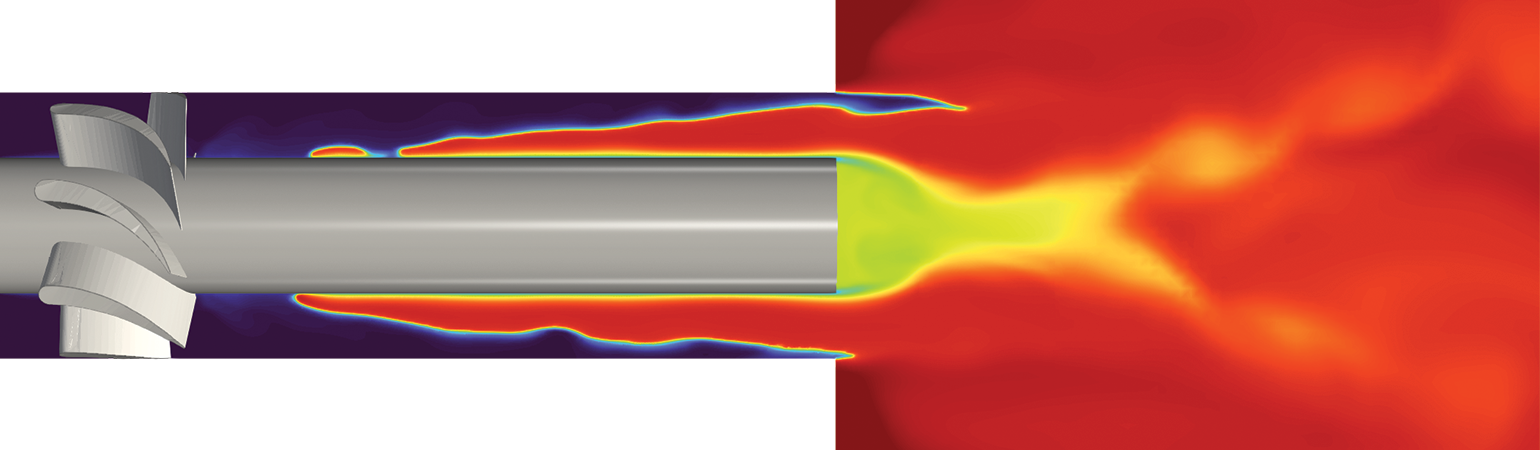
From boilers and gas flares to stoves and science laboratories, burners are key pieces of equipment in both industrial and home settings. Because burners are so widely used, increasing their efficiency and reducing their emissions could make a significant impact on both indoor and outdoor air quality. Computational fluid dynamics (CFD) simulations allow engineers to analyze different burner designs under different operating conditions to identify promising configurations before building costly prototypes and conducting expensive tests. Furthermore, CFD is a valuable tool for efficiently diagnosing problems and assessing solutions for burners out in the field.
CONVERGE CFD software offers a suite of models and features that help balance the need for accuracy with the need for speed in the burner industry. High-fidelity models enable highly accurate, predictive solutions, while simplified models and efficient solvers provide enhanced speed for time-sensitive simulations.
Fast Chemistry Modeling
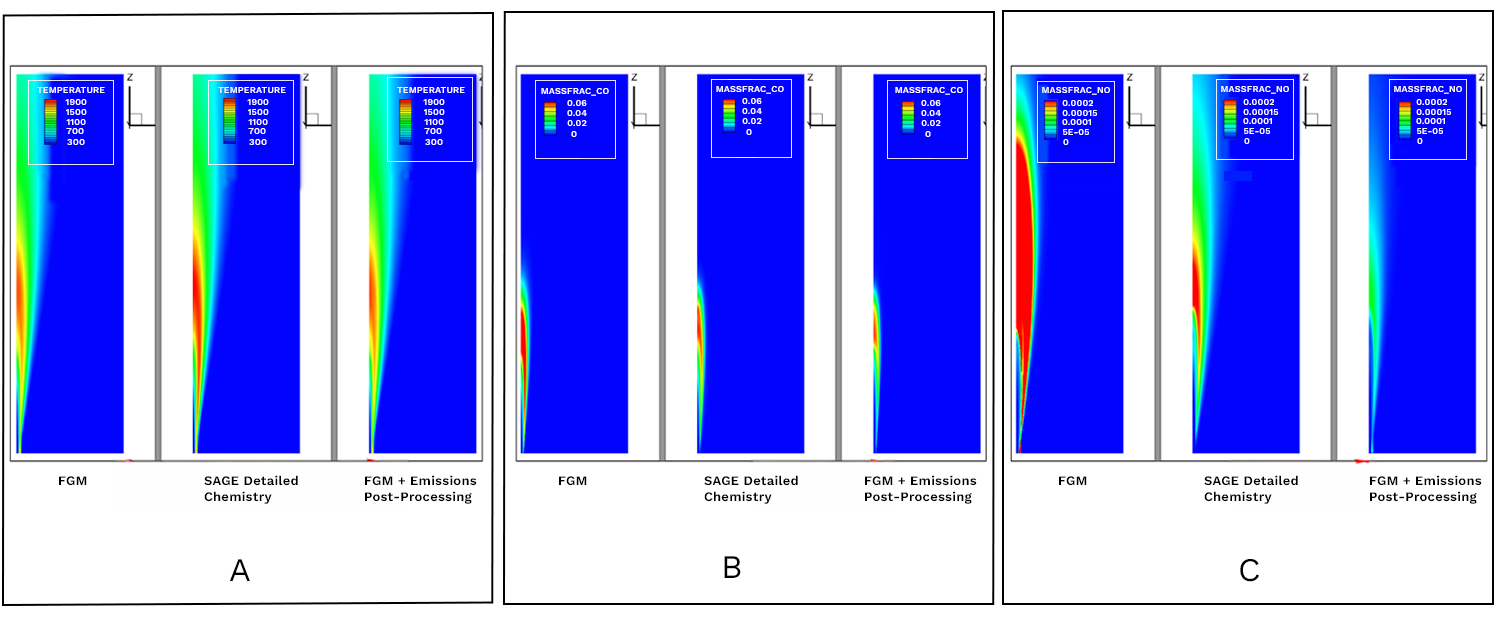
When you need results quickly, you can take advantage of CONVERGE's simplified combustion models to run highly efficient burner simulations. These models include single-step chemistry, the Eddy Dissipation Model (EDM), and the Flamelet Generated Manifold (FGM) model. While not as accurate and predictive as detailed chemistry, these models offer insight into important combustion characteristics such as flame shape, fuel-air mixing, temperature distributions, and combustion efficiency.
For cases that require a high level of accuracy, CONVERGE's SAGE detailed chemistry solver provides high-fidelity, predictive results for combustion simulations. SAGE allows you to capture complex phenomena such as ignition, premixed flame propagation, flame flashback, lean blowout, and emissions. While not as fast as the simplified combustion models, SAGE is designed to be as efficient as possible, even with large chemical mechanisms.
To complement the SAGE solver, CONVERGE provides access to a large database of chemical kinetics mechanisms for single- and multi-fuel simulations through C3Mech. Developed by the Computational Chemistry Consortium, C3Mech is a comprehensive, well-validated detailed chemistry mechanism for surrogate fuels that is integrated into CONVERGE Studio for easy access.
Low-Cost Emissions Predictions
Accurately predicting emissions typically requires a detailed chemical mechanism; however, CONVERGE offers a faster alternative: emissions post-processing. With this method, you can run a fast burner simulation using a simplified combustion model until the simulation reaches steady-state. Then, using that solution, you can run a 3D simulation using detailed chemistry for only a couple of time-steps to calculate the emissions under steady-state conditions. This method allows you to obtain emissions values for important species such as CO, NOx, and soot very quickly.
Accelerated Solutions With Steady-State Combustion
Because burners are designed to run under stable operating conditions, steady-state simulations can provide meaningful results in a short amount of time. CONVERGE's Under-Relaxation Steady (URS) solver offers fast and reliable convergence for burner simulations. The URS solver can be used in conjunction with a variety of combustion models, including SAGE, FGM, and EDM. Compared to CONVERGE's previous steady-state solver, the URS solver can significantly accelerate steady-state simulations when used with simplified combustion models.

Autonomous Meshing for Rapid Design Iteration
Manually creating a computational mesh for your burner simulation can be a time-consuming and tedious task, especially for large domains and complex geometries. CONVERGE eliminates user meshing time through its fully autonomous meshing capabilities. The solver automatically generates a high-quality mesh at runtime that accurately captures the complexity of your geometry. Autonomous meshing is especially useful if you're testing many different design options-with no need to manually modify the mesh for each case, your workflow is significantly accelerated, allowing you to test more designs in the same amount of time.
In addition to creating the initial mesh, CONVERGE automatically adjusts the mesh throughout the simulation via Adaptive Mesh Refinement (AMR). AMR adds resolution based on the curvature of field variables such as velocity and temperature to capture combustor flow and propagating flames, while coarsening the mesh in other areas to reduce computational expense. Applicable to both transient and steady-state cases, AMR helps improve the accuracy of your simulation while minimizing runtime.
Mitigate Flame Flashback
Flame flashback in burners occurs when the flame propagates upstream at a greater speed than the incoming gas flow, potentially causing significant damage to the burner hardware. Burners fueled with hydrogen or hydrogen blends are at greater risk of flashback, and mitigating the phenomenon can help improve performance and extend the lifespan of the burner. To predict flame flashback, you need to capture the complex interplay between unsteady fluid dynamics and chemical reactions-which CONVERGE accomplishes through high-fidelity simulations using detailed chemistry and accurate turbulence modeling.
To prevent flame flashback, flame arrestors are sometimes placed in the burner intake. Flame arrestors are composed of many narrow channels that absorb heat from the flame as it propagates through the device, lowering the temperature of the flame enough to quench it.
CONVERGE offers two approaches to simulate flame arrestors: (1) a high-fidelity, but computationally expensive, approach using detailed chemistry and conjugate heat transfer modeling and (2) a faster, but lower fidelity, approach using porous media modeling. When you use porous media modeling, you remove the need to resolve the flow through the fine-scale flame arrestor geometry, instead modeling the flow effects as distributed momentum resistances. The porous media model can be coupled with heat transfer modeling to quickly assess the efficacy of a flame arrestor for preventing flashback in your burner design.
Capture Other Important Physics
Burners involve many complex, multi-physics interactions that are important to capture in your simulation. In addition to the previously discussed models, CONVERGE offers a variety of other models useful for burner simulations, including conjugate heat transfer, radiation, and turbulence.
Conjugate Heat Transfer
CONVERGE's conjugate heat transfer (CHT) modeling, which simultaneously predicts heat transfer in the fluid and solid portions of the domain, can be used to calculate metal temperatures in burner simulations. Because CHT modeling can be computationally expensive, CONVERGE includes a feature called super-cycling, which periodically freezes the fluid solver while the solid heat transfer is allowed to progress to steady state. Super-cycling significantly reduces the computational cost of a CHT simulation without a significant impact on accuracy.
Radiation
Radiation modeling is important for capturing radiative heat loss in burners, which can affect efficiency and emissions production. CONVERGE offers both reduced-fidelity models (e.g., P1 model) and high-fidelity models (e.g., discrete ordinates models) that allow you to simulate radiation and the associated heat transfer.
Turbulence
Burners can be turbulent environments, and accurately capturing burner behavior thus requires an appropriate turbulence model. CONVERGE includes a spectrum of turbulence models—including Reynolds-Averaged Navier-Stokes (RANS), large eddy simulation (LES), and hybrid RANS-LES models—that you can choose from to strike the right balance between simulation efficiency and accuracy.
Events
Resources










Contact Us Today
Learn more about how CONVERGE helps you quickly and accurately solve your CFD problems.