

Wind Energy
Wind energy is a cornerstone in the global battle against climate change. Advancements in technology allow engineers to better harness the power of wind to provide a sustainable source of power for both large-scale grids and remote communities. CFD enables engineers to investigate complex aspects of wind turbine design, such as aerodynamic forces, turbulence, and wake effects, all of which can directly impact the turbine’s energy output and overall performance. CFD can also be used to model the effects of environmental factors like wind speed or direction, turbulence intensity, and wind and wave loads for offshore wind turbines.
CONVERGE includes a wide assortment of features and modeling capabilities that can help generate accurate and efficient wind turbine simulations.

Understanding Wind Turbine Rotors
Accurate rotor modeling is essential in the design, optimization, and maintenance of wind turbines. However, complete CFD rotor simulations can be extremely expensive for large-scale problems, including wind turbines or wind farms. As such, CONVERGE offers two refined hybrid techniques that can capture the interaction between the rotor and the bulk fluid field without directly resolving the rotor blade fluid dynamics. These methods do not require the blade geometry or manual mesh setup, allowing engineers to run fast simulations on a coarse grid.
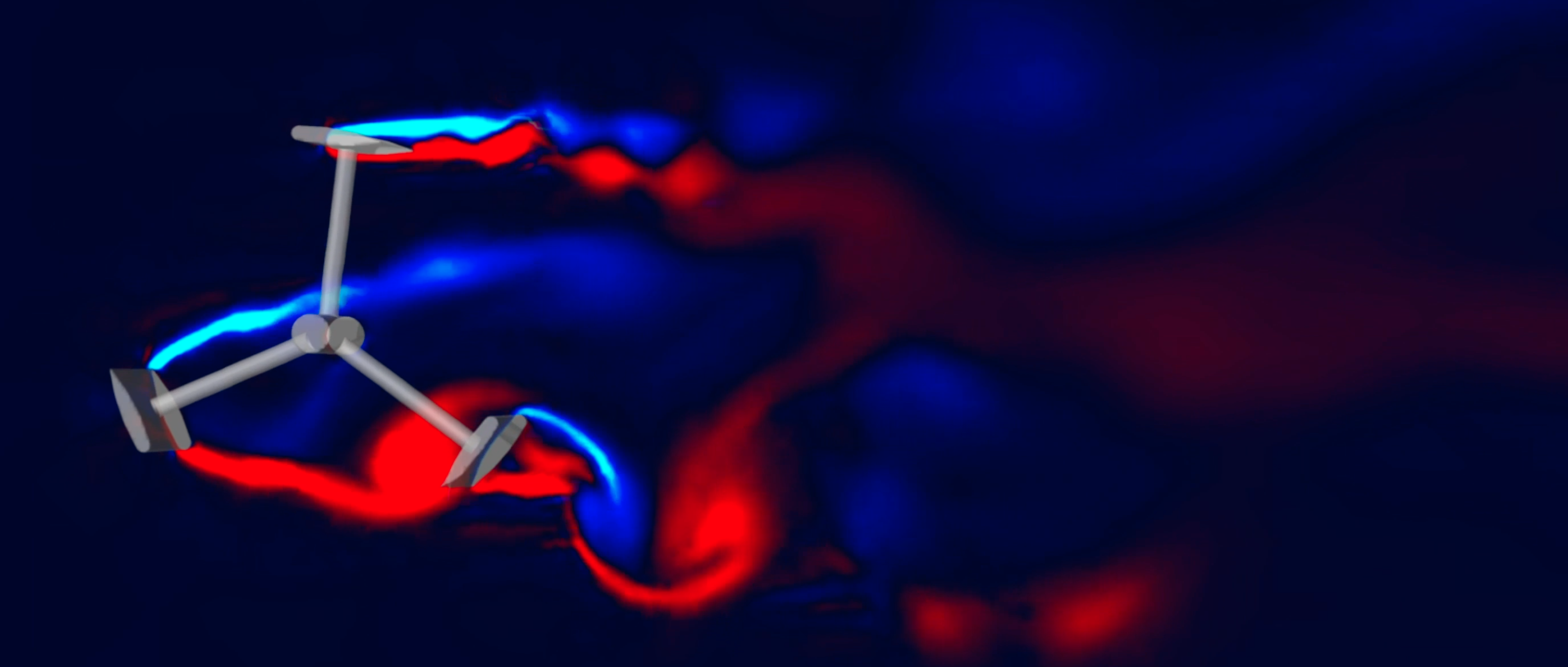
The actuator-line model (ALM) represents each 3D rotor blade as a 1D line with a finite number of elements, where each element is modeled as a 2D airfoil with prescribed aerodynamic properties. This method significantly speeds up wind turbine simulations, while still accurately capturing essential 3D flow structures. CONVERGE’s ALM includes novel approaches for velocity sampling and force projection, which further increase its accuracy and efficiency.
Another rotor model available in CONVERGE is the refined actuator-disk model (RADM), which represents the rotor as a disk that is divided into multiple sections using a polar coordinate system independent of the CFD mesh. Unlike the ALM, this technique is based on a rotor modeling that speeds up the simulations, allowing the temporal discretization of the simulation to be reduced.
CONVERGE includes additional sub-models that may be activated for both ALM and RADM, allowing for more realistic representations of aerodynamic forces, including dynamic stall, stall delay, and tip loss corrections.
Tapping Into the Power of Wind Energy
Wind Farm Simulations
Simulating wind farms can be challenging due to the complex interactions between turbines, including wake effects and turbulence, as well as wind conditions and other environmental factors. CONVERGE offers an array of features and modeling capabilities that have been shown to produce accurate simulation results for real-world wind farms.
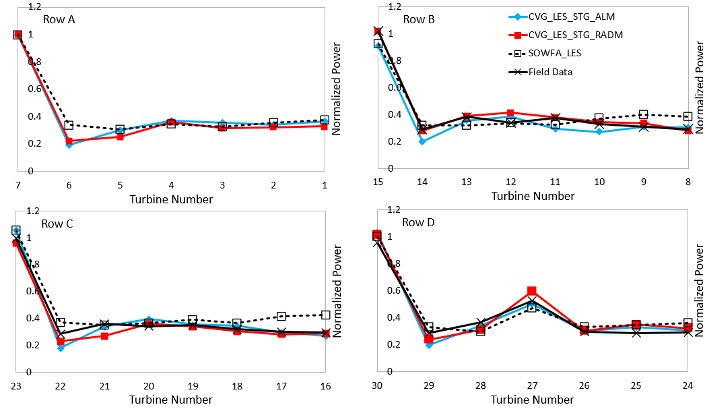
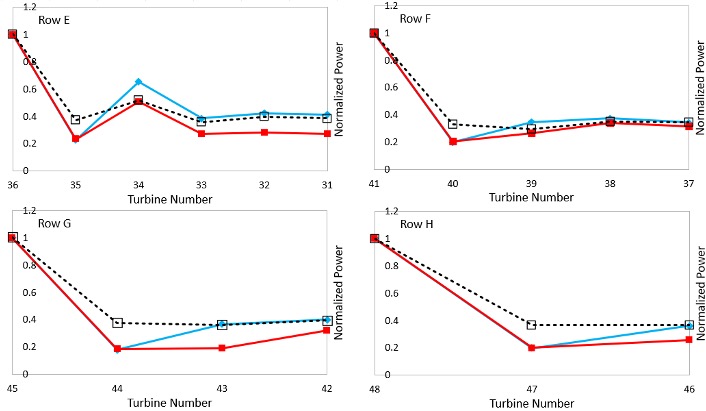
In this case study, we simulated the Lillgrund wind plant in Sweden, which is composed of 48 fixed-bottom Siemens SWT wind turbines, each with a rotor diameter of 93 m and a rated power production of 2.3 MW. We ran two CONVERGE simulations of this wind farm, one using ALM and the other using RADM. Both cases were run with the Dynamic Smagorinsky turbulence model. Comparisons of turbine power between experimental results and CONVERGE simulations are shown in Figure 1. The RADM case had a total cell count of 4.3 million cells, which allowed it to run much faster than the ALM case, which had 30 million cells. Even so, performing a blade-resolved CFD simulation would have necessitated a far greater cell count than either the ALM or RADM cases. Both CONVERGE cases produced accurate outputs that demonstrated strong agreement with experimental measurements.
Layout Optimization
The layout of a wind farm can dictate overall energy output, operational efficiency, and project costs. In a poorly laid out wind farm, wake effects generated by upwind turbines may decrease the performance of downwind turbines. Machine learning (ML) for the optimization of wind farm layouts is a new technological development that can accurately predict turbine interactions to prevent negative wake effects and ensure each turbine receives optimal wind flow.
CONVERGE includes an ML tool that can help improve wind farm efficiency at a relatively low computational cost. Using the tool, you can set up a design of experiments (DoE) study to produce data to train an ensemble ML model that emulates CFD results. You can then use the trained ML model to predict the optimal layout of your wind farm, and confirm the results in CONVERGE. ML optimization not only provides rapid project turnaround times compared to traditional optimization methods like genetic algorithms, but is also cost-effective thanks to CONVERGE Horizon, which provides convenient and affordable access to advanced cloud computing resources.
CONVERGE Over Complex Terrain
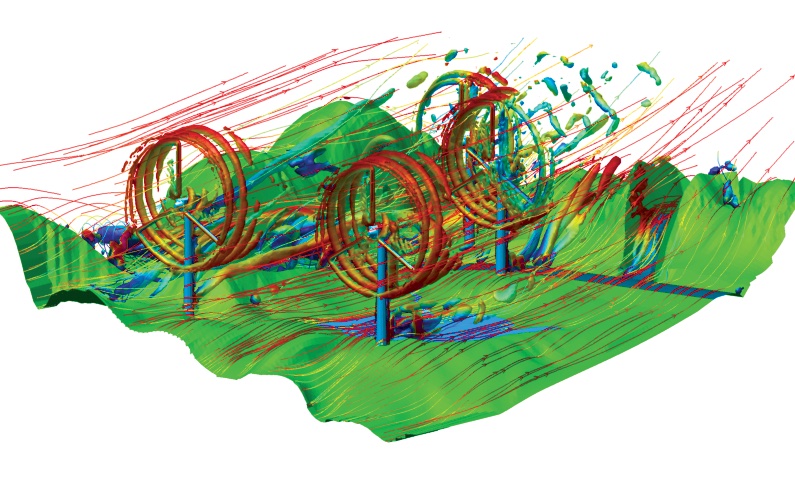
Historically, wind farms are built in areas with relatively flat terrain. However, in recent years, wind farms with smaller-scale wind turbines—like vertical-axis turbines—have been established in more urban areas, such as in public city squares or building rooftops. To determine the best locations for wind turbine placement over complex terrain, engineers must first understand how buildings and other obstacles will affect airflow patterns and, as a result, the power output of the turbines. With fully autonomous meshing, CONVERGE makes it easy to incorporate these obstacles into the simulation and observe their influence on flow patterns and power generation. You can use CONVERGE’s fixed embedding to include a refined mesh around obstacles of interest, and Adaptive Mesh Refinement (AMR) to automatically add and remove cells during the simulation to efficiently resolve important flow phenomena.
Offshore Wind Energy
Offshore winds are typically stronger and steadier than onshore winds, making them a source of untapped potential for wind energy production. Recent technological advancements have turned the vision of harnessing offshore winds into a tangible reality, paving the way for the future of sustainable energy. CONVERGE includes a comprehensive set of tools for simulating offshore wind turbines, including wind and wave generation, wind-wave coupling, and mooring cables.
Environmental Flow Generation
Modeling environmental flows with CFD is crucial for understanding the complex interactions between fluid flow and offshore wind turbines. By modifying inflow and initial conditions, CONVERGE can generate different types of waves (e.g., linear, nonlinear, regular, irregular) and wind profiles (e.g., log law, power law). You can also add wave relaxation zones, which are designated areas within a computational domain used to gradually dissipate and absorb reflected waves. These zones damp out the wave, preventing them from bouncing back unphysically and interfering with simulation results.
CONVERGE’s volume of fluid (VOF) modeling can dynamically couple the wind and wave fields to generate an accurate assessment of their interaction; for example, while the wind shear drives the waves, the waves can cause additional oscillations to the wind. Additionally, CONVERGE’s free surface models, including VOF methods like the void fraction solution (VFS) or Individual Species Solution (ISS), are available to capture multi-phase flow, with front capture methods (e.g., HRIC, PLIC, FCT) for the air-water interface.
Floating Offshore Wind Turbines
Floating offshore wind is a rapidly growing industry that is poised to play a major role in the global transition toward sustainability. These floating systems have the ability to access deeper waters with higher wind potential, in addition to having reduced noise and environmental concerns. Floating wind turbines can move with six degrees of freedom, allowing for translation and rotation along all three axes. While this technology allows for maximal wind energy generation, it significantly complicates the prediction of load, performance, and dynamic response. CFD can enable accurate modeling of complex fluid-structure interactions, allowing researchers to perform full simulations without the restrictions of repetitive prototype testing.
CONVERGE offers a suite of tools for simulation of floating offshore wind turbines. The rotor models (ALM, RADM) allow efficient capture of the operation and effects of the turbine rotors. An inlaid or cut-cell Cartesian mesh can simulate the platform geometry, while fluid-structure interaction (FSI) modeling is available in six degrees of freedom (6DOF) to accurately simulate the interaction between the wind, waves, and turbine.
While offshore wind turbines in shallow-to-intermediate waters are attached to monopiles, floating turbine platforms installed in deeper waters are constrained by mooring cables. The dynamic cable model in CONVERGE employs a finite segment method to efficiently calculate the applied forces from the mooring cables, which are then applied in the FSI calculations.
Convergent Science is an active participant in the efforts to validate modeling tools for FOWT systems as part of the Offshore Code Comparison Collaboration, Continued with Correlation and unCertainty (OC6) and OC7 projects. Under these projects, CONVERGE’s hydrodynamic and aerodynamic FOWT modeling capabilities have been evaluated and verified against experimental data.1,2
The Sound of Wind: Aeroacoustic Modeling
Sound is generated and transmitted directly by turbulent fluid motion and aerodynamic forces. Fundamentally, acoustic waves are weak longitudinal pressure/density disturbances that propagate through a compressible fluid. In a liquid or gas, they obey the governing Navier-Stokes equations that apply to bulk fluid dynamics; in principle, they can be resolved by direct numerical simulation (DNS) or large eddy simulation (LES). While the direct simulation of acoustic disturbances can be practical over very short distances, it can be extremely expensive for wind turbines, which have large length, time, and velocity scales. For example, an acoustic wave at 20 kHz would require a base grid spacing of 1 mm. In the domain of interest for a wind turbine simulation, the wave can meaningfully propagate for hundreds of meters, which would be at least five orders of magnitude greater than the base grid spacing necessary to resolve it.
To address this restriction, CONVERGE includes two classes of reduced-order computational aeroacoustic models. Far-field models derive a wave equation from the Navier-Stokes equations that can predict acoustic transmission and spectral information over long distances (>km). For example, the Ffowcs Williams-Hawkings model describes the acoustic properties of a fluid based on information about volume addition, unsteady momentum fluxes, and turbulent shear layers. Near-field models use solved turbulence quantities in the flow domain and are useful for visualizing where acoustic energy is being generated within a flowfield. The Proudman model identifies volumetric or turbulent noise sources by approximating the acoustic power based on volume. Another near-field modeling option is the Curle model, which predicts surface noise sources by approximating the acoustic power based on area.
References
[1] Darling, H., Schmidt, D.P., Xie, S., Sadique, J., Koop, A., Wang, L., Wiley, W., Archeli, R.B., Robertson, A., and Tran, T.T., “OC6 Phase IV: Validation of CFD Models for Stiesdal TetraSpar Floating Offshore Wind Platform,” Wind Energy, 28(1), 2024. DOI: 10.1002/we.2966
[2] Liao, Y., Wang, L., Robertson, A., Jonkman, J., Koop, A., Campaña-Alonso, G., Aromatario, D., Maximiano, A., Darling, H., Schmidt, D.P., Xie, S., Sadique, J., Bohbot, J., Fernández-Ruano, S., Hirabayashi, S., Iwamoto, Y., Yoshimoto, H., Nishimura, S., Trubat, P., Wang, M., Jiang, C., and Kim, Y., “OC7 Phase I: CFD Investigation of Viscous Forces on Rectangular Members of Semisubmersibles,” Ocean Engineering, 2026. DOI: 10.1016/j.oceaneng.2026.124908


