
Applications









Marine
Marine Applications
From the earliest Polynesian open-ocean voyages to the vast web of freighters bridging continents today, maritime transport has existed for millennia. After sailboats turned to steamboats turned to motor vessels, and propulsion systems became far more complex, engineers began to optimize ship design through computational fluid dynamics (CFD). However, modeling marine applications comes with a host of challenges, including complex moving geometries, fluid-structure interactions, and cavitation. CONVERGE CFD software is well-equipped with powerful features to address these challenges, allowing you to generate results accurately and efficiently whether you're modeling a container ship or a canoe.
Fluid-Structure Interaction Simulation
Fluid-structure interaction (FSI) occurs when a moveable structure interacts with the fluid surrounding it. Capturing fluid-structure interaction is critical for achieving accurate marine simulations, which often consist of a solid object such as a propeller or boat hull interacting with water. CONVERGE predicts how these rigid objects move based on the flow, solving for fluid pressure and viscous forces at each time-step to advance the specified FSI objects. The solver allows for objects with up to six degrees of freedom, enabling both translational and rotational movement in all six directions.
In cases where the fluid domain density is similar to or significantly higher than the solid domain density, FSI simulations can become unstable. CONVERGE overcomes this instability through an implicit coupling method, which solves the fluid and solid domains in a tightly coupled manner.
Capturing Multi-Phase Dynamics
CONVERGE offers a variety of robust techniques for modeling multi-phase flows, including both Lagrangian and Eulerian methods. Lagrangian modeling tracks individual parcels as they move through a flow field, which can be useful for simulating marine phenomena such as spray formation near breaking waves. The Eulerian volume of fluid (VOF) method, on the other hand, treats the phases as continuums and tracks the volume of fluid within each cell. In marine applications, VOF modeling is useful for hull optimization and wave-structure interactions.
To maintain a sharp interface when modeling multi-phase flows, it can be helpful to use an interface capturing scheme to generate precise information about the shape or location of an interface. CONVERGE includes several capturing schemes: flux-corrected transport (FCT), piecewise linear interface capturing (PLIC), high-resolution interface capturing (HRIC), and surface compression.
Autonomous Mesh Generation
It can be tedious to make meshes manually for the complex moving geometries involved in marine applications. CONVERGE eliminates this frustration through autonomous meshing with Adaptive Mesh Refinement, automatically generating the mesh at runtime and refining it at each time-step. You can also use void-fraction AMR to concentrate cells at the air-water interface, which helps resolve the interface at a lower overall cell count. This accelerates your workflow and produces highly accurate results while maintaining a potentially lower computational cost.
Specialized Flow Profiles
Marine applications often involve phenomena that require complex boundary conditions not easily represented by a simple spatial or temporal flow profile. CONVERGE contains specialized flow profiles for surface waves and wind to replicate real-world environmental flows. You can also include wave relaxation zones in your simulations, which improve numerical stability and prevent unrealistic reflections at inflow and outflow boundaries.
Propeller Modeling
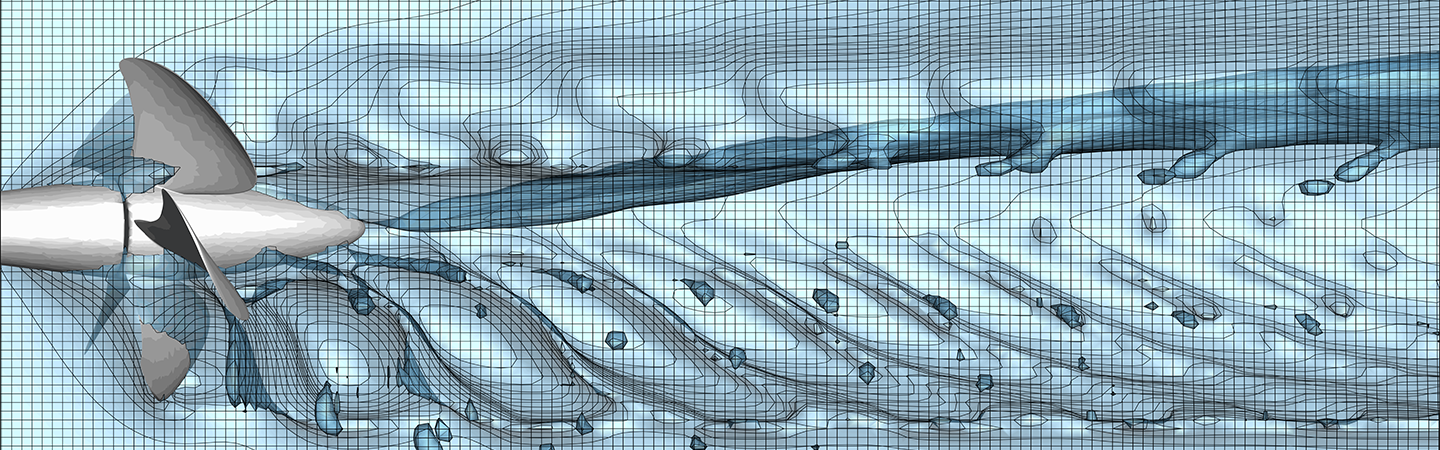
A ship's propellers are vital to its performance, converting rotational power from the engine into thrust. Quality propeller design can improve maneuverability, increase fuel efficiency, and even enhance passenger comfort by reducing sound level and shaking on board. CONVERGE can help you optimize for these characteristics by generating fast and accurate simulations of fluid flow around a propeller's blades.
Potsdam Propeller Test Case (PPTC)
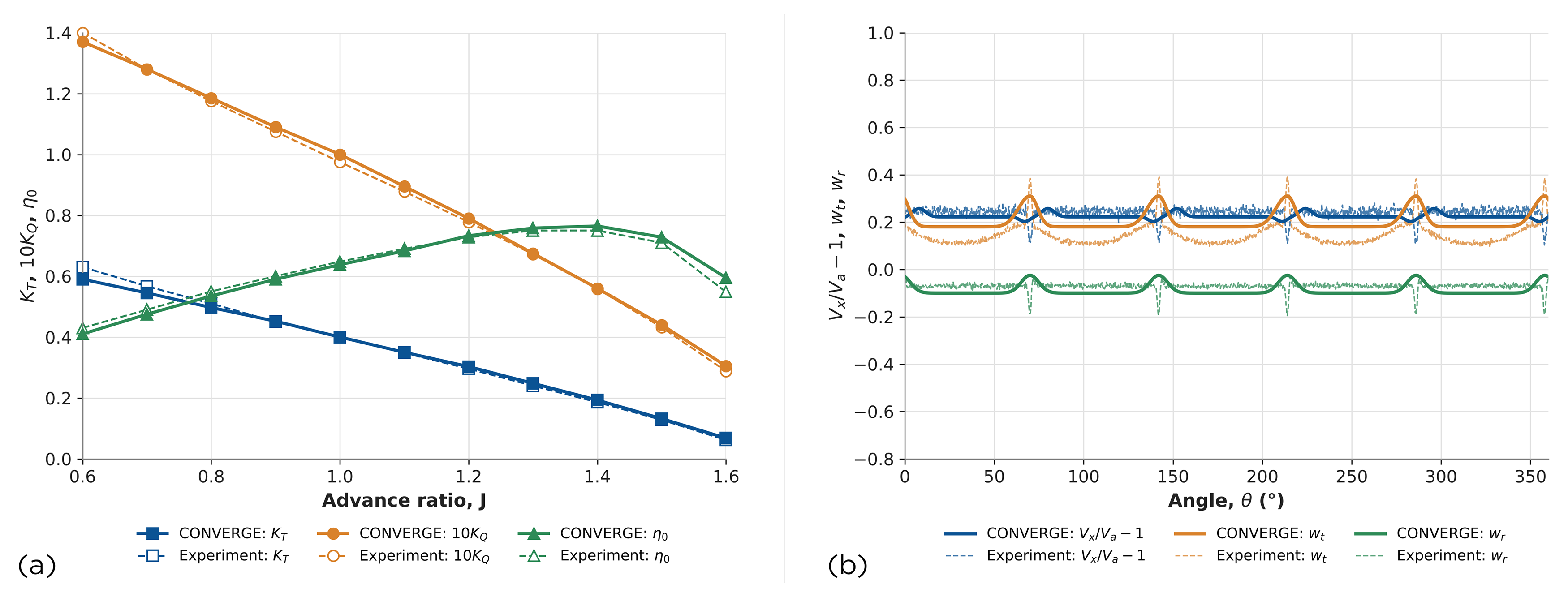
The Potsdam propeller test case (PPTC) is a benchmark case used to evaluate the accuracy of CFD codes for ship propeller simulations. In a steady-state CONVERGE simulation of the PPTC, we employed the multiple reference frame (MRF) approach to speed up the simulation runtime, as well as the k-ω SST model to capture turbulent flow. CONVERGE's predictions for the case aligned well with experimental results (Figure 1a).
We also modeled a controllable pitch propeller from the PPTC in a transient simulation, again using the k-ω SST turbulence model, in addition to velocity- and helicity-based AMR. Once more, CONVERGE predictions agreed with the experimental Laser Doppler Velocimetry (LDV) measurements of axial, tangential, and radial velocity (Figure 1b).
Actuator-Disk Model
Rotor models can mimic the effects of a rotating propeller while cutting down on computational costs. CONVERGE offers the actuator-disk model (ADM), which treats the rotor as a disk with prescribed values for shear stress and torque. This simplified model speeds up propeller simulations and allows you to quickly capture boat rotation, acceleration, and deceleration.
Boat Hull Modeling
CONVERGE allows you to experiment with boat hull designs before constructing costly physical prototypes. In this way, you can optimize hydrodynamic performance, reduce drag, and improve fuel efficiency while saving time and money.
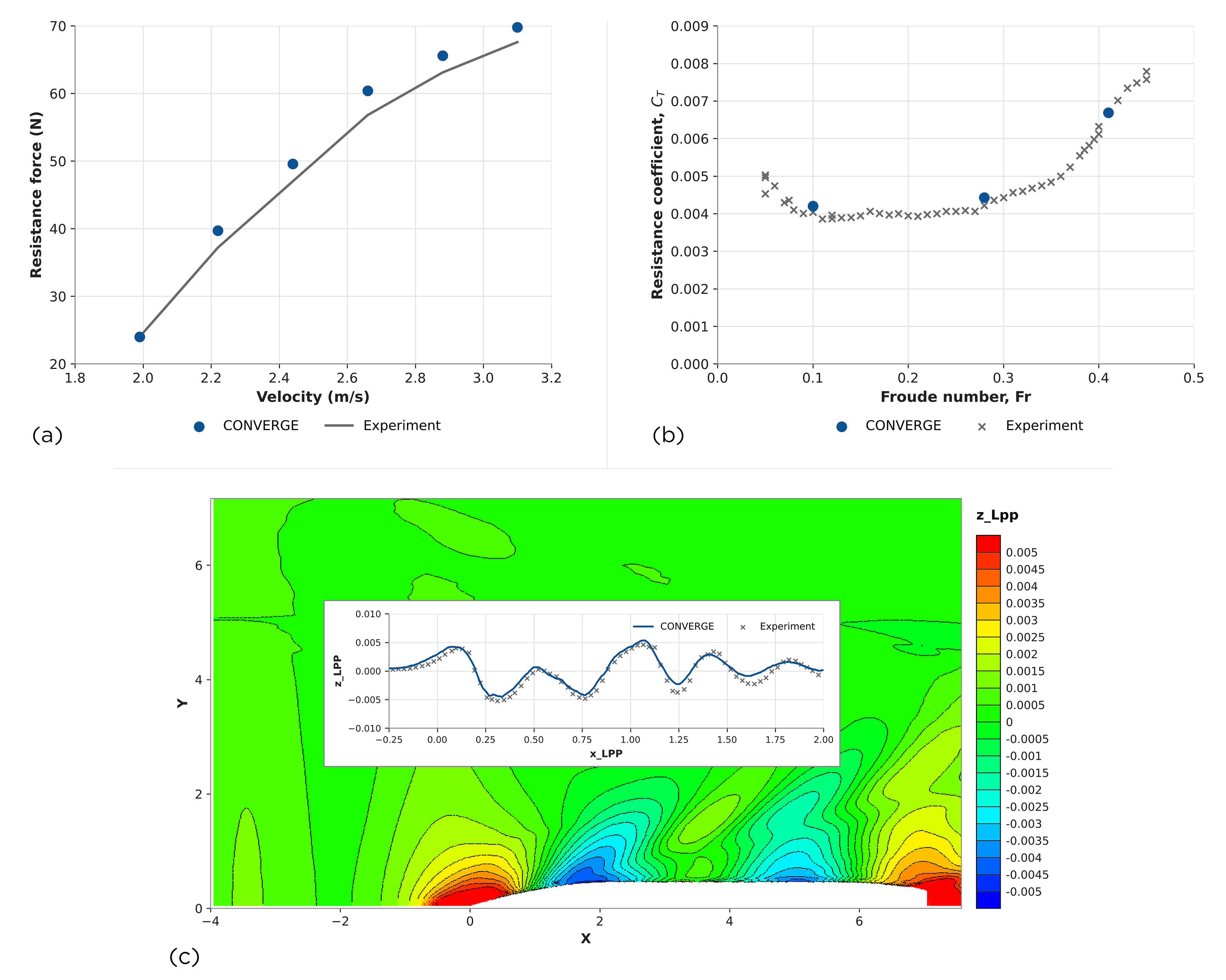
CONVERGE's boat hull modeling capabilities have been validated against a variety of canonical cases. In a simulation of the SYSSER50 boat hull, CONVERGE accurately predicted the boat's resistance force as it moved through the water using both LES and RANS turbulence models (Figure 2a). We also modeled the DTMB5415 case in CONVERGE in a transient, multi-phase simulation with VOF modeling and the RNG k-ε turbulence model. The HRIC scheme with surface compression accurately captured the multi-phase interface, and the CONVERGE predictions matched well with test data at fixed sink and trim (Figure 2b). In addition to these examples, we have validated CONVERGE against experimental data for several other cases, including the KCS container ship case (Figure 2c).
Cavitation
As a ship plows through the water at high speeds, it is possible for the surrounding water pressure to drop quickly, causing tiny vapor bubbles to form. This vaporization process can also occur when rotating propellers create areas of low pressure on their backsides. When those vapor bubbles collapse, they can generate shockwaves that damage the hull or propeller surface. The formation and collapse of those vapor bubbles is called cavitation, and it can lead to boat vibrations and reduced efficiency. CONVERGE contains several homogeneous mixture and homogeneous relaxation models to help you mitigate and reduce the cavitation phenomenon, including the Singhal, Saito, and Schnerr and Sauer models.
Offshore Energy
CONVERGE has powerful capabilities for modeling offshore energy applications, including offshore wind energy and offshore oil and gas applications. Learn more about these topics on the Wind Energy and Oil and Gas webpages!
Events
Resources










Contact Us Today
Learn more about how CONVERGE helps you quickly and accurately solve your CFD problems.