

Exhaust aftertreatment systems are a key safeguard to help keep pollutants generated by vehicle engines from being released into the environment. As such, our aim is for aftertreatment systems to be as efficient and effective as possible. When you're trying to maximize the efficacy of a system, computational fluid dynamics (CFD) is a powerful tool. CFD simulations enable you to analyze many different designs to identify top-performing candidates before building and testing expensive physical prototypes.
Modern computing technologies are allowing engineers to push ideas even more, enabling larger and more economical optimization studies. And manufacturers are continuously exploring how new technologies can further push the bounds of innovation.
Researchers at the Aramco Americas Detroit Research Center are investigating the potential of graphics processing units (GPUs) to help accelerate their CFD simulations. The Aramco Research Center - Detroit is focused on developing advanced transport technologies, for passenger vehicles all the way up to heavy-duty and stationary engines.
Dr. Pei leads the Computational Modeling Team at Aramco, and he and team member Dr. Mickael Silva are working to develop a more accurate method for modeling the flow through automotive three-way catalysts (TWCs).
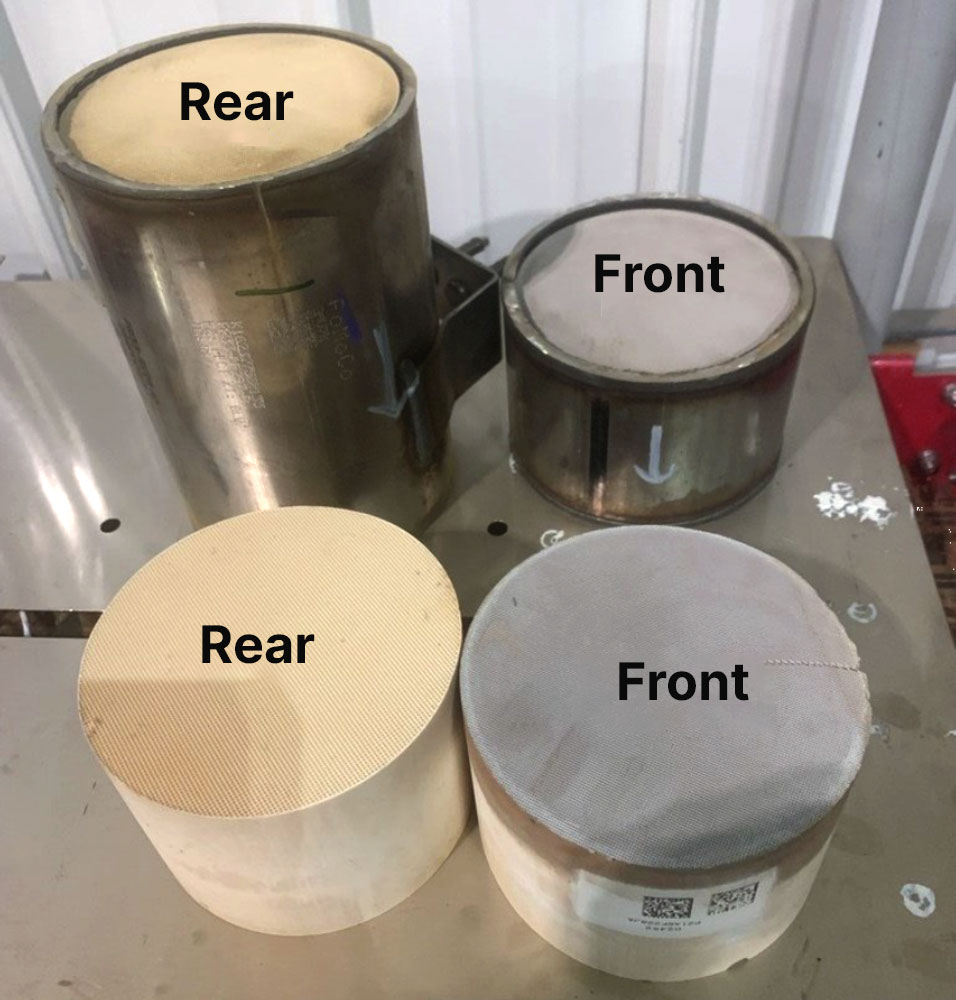
For gasoline-fueled vehicles, TWCs are used to reduce engine-out emissions of carbon monoxide (CO), hydrocarbons (HCs), and nitrogen oxides (NOx). Modeling these devices is challenging, and many current techniques rely on empirical correlations that require extensive calibration, which can prolong the hardware development cycle.
"Our desired path is to build physics-based models that represent the key mechanisms governing flow and transport inside the catalyst system," says Dr. Silva. "We want to establish a comprehensive modeling framework composed of modular 'building blocks,' including flow through monolith channels, surface roughness effects, surface chemistry, and other coupled phenomena."
"Research and innovation are key for tackling difficult challenges, and we believe that advanced computational tools and collaborations can help us accelerate this important work," adds Mohammad Askar, Director of R&D.
The Aramco engineers collaborated with NVIDIA and teamed up with the Convergent Science HPC and Solver Development teams, to tackle this project using CONVERGE CFD software's new GPU solver.
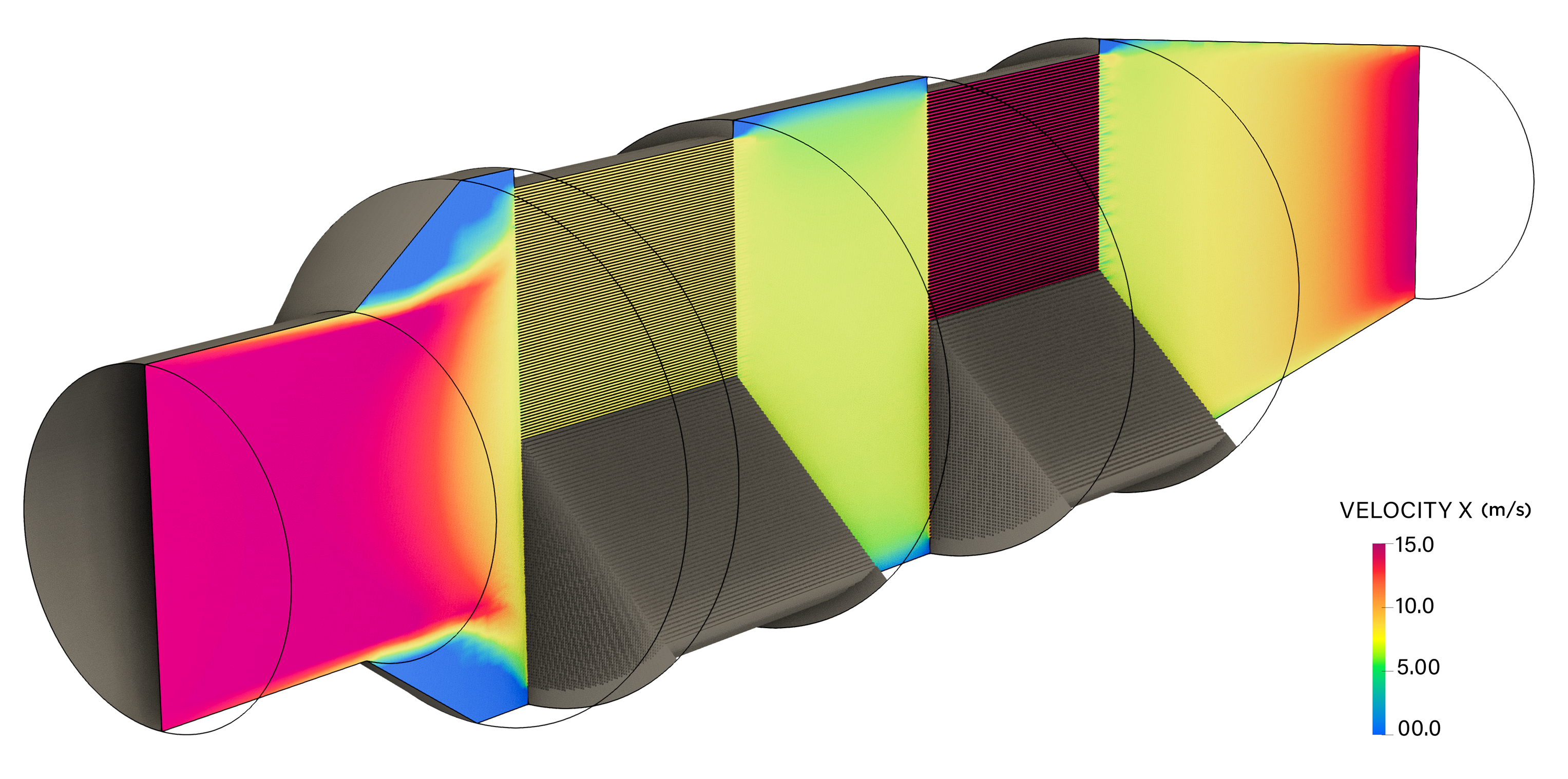
As a first step, the team focused on flow across two consecutive catalyst bricks using a simplified model that assumes smooth walls. This simplified model will provide insight into the governing flow physics, and future studies will address the effects of surface roughness when added into the simulations. The aim of the initial simulation is to capture the pressure drop across and within the catalyst.
The team used the updated GPU solver recently released in CONVERGE 6 to run the simulation on a single HGX B200 system with eight NVIDIA Blackwell GPUs.
"Engineers are turning to GPU-accelerated simulation to speed the design of next-generation vehicle technologies," said John Linford, Director of CAE Product at NVIDIA. "By running CONVERGE 6 on NVIDIA Blackwell GPUs, Aramco is showing how GPU-based CFD helps advance catalyst design with larger, faster simulations that support lower-carbon, more efficient mobility."
With this setup, the team was able to simulate 0.75 seconds of physical time in under 25 hours, with simulations that reached beyond 100 million cells. Achieving a fast turnaround time for these types of simulations will enable the exploration of multiple relevant operating conditions and help accelerate early-stage technology screening.
The results from the simulation were post-processed to study the flow inside the geometry. Figure 2 shows a visualization of the flow velocity as it travels through the TWC. The qualitative results suggest some level of flow laminarization inside the microchannels, which will affect the mixing characteristics within the device. This becomes even more critical in current engine architectures, where packaging is tighter and only a small space is available for flow mixing.
"CONVERGE 6 now has multi-GPU capabilities and we have extended its trusted, CPU-proven features to GPU architectures," says Sparsh Ganju, Senior Research Engineer at Convergent Science. "We have introduced support for compressible flows, turbulence modeling, and combustion simulations, enabling our clients to run complex, real-world simulations such as this one on GPUs."
The success of this initial study demonstrates the feasibility of incorporating more high-fidelity simulations into the development process of automotive emissions-control devices. With additional multi-physics capabilities coming in future versions of CONVERGE's GPU solver, the Aramco team plans to continue to improve predictive fidelity and further accelerate innovation in TWC modeling.
Bringing together advanced simulation software and state-of-the-art hardware, this cross-industry collaboration highlights an innovative approach to catalyst design, enabling faster, more accurate models aimed at reducing emissions and advancing the future of mobility.