

Every computational fluid dynamics (CFD) engineer is familiar with the pressure to get simulation results as quickly as possible, whether you're rushing to get a new product to market, frantically trying to diagnose a system failure in the field, or simply trying to finish your Ph.D. in a reasonable amount of time. There are many computational tricks you can use to reduce simulation runtime: employing simplified models, running on a coarser mesh, or strategically ignoring some of the more complex physics. But sometimes, the tradeoff in loss of accuracy is too much; or, even with these acceleration techniques, the runtime can still be prohibitive. What can you do then?
One option is to look to your computing hardware. If you can run your simulation on faster processors, you can get your results that much quicker without having to sacrifice accuracy. Luckily, hardware manufacturers like Intel are working hard to develop faster central processing units (CPUs) capable of keeping up with the demands of today's CFD workloads.
To highlight the continued advancements in processor power, we teamed up with Intel to investigate the performance of their latest generation of CPUs. We simulated a test case on three generations of Intel® Xeon® processors, demonstrating that each new generation is outpacing the last, delivering results faster than ever.
Testing Processor Speed With Supersonic Flow
For our test case, we chose to simulate a supersonic flow in a channel using CONVERGE CFD software version 5.1.1. The case is designed to mimic the flow in a scramjet, i.e., a supersonic combustion ramjet engine. In a scramjet, the vehicle carries no onboard oxidizer, instead relying on atmospheric oxygen to sustain combustion. Because the air is thin in the upper atmosphere where these vehicles operate, they must be flown at extremely high speeds to sufficiently compress the air in the intake to sustain the combustion reaction.
When operating correctly, we expect to see a steady shock-train structure inside the channel with predictable and stable attachment points, as shown in the video in Figure 1. To capture the shock-boundary layer interaction, we employed the two-equation k-ε large eddy simulation (LES) turbulence model. We applied an inlet condition with turbulent fluctuations to mimic real-world turbulent atmospheric air and a fixed-pressure outlet.
For grid generation, CONVERGE's autonomous meshing automatically constructs a high-quality Cartesian mesh at runtime. We did not use Adaptive Mesh Refinement for these simulations to ensure a consistent cell count across processor generations.
Hardware Configuration
We ran the simulation on one node each of 4th, 5th, and 6th generation Intel® Xeon® processors; the configuration details for each processor are listed in Table 1. For the Xeon® 6 processors, we ran the simulation with both a DDR5 configuration and an MRDIMM (Multiplexed Rank DIMM) configuration. MRDIMM is a new memory technology that Intel pioneered to provide higher memory bandwidth and lower latency compared to the traditional DDR5 technology. It's designed as a drop-in replacement for regular DDR5 memory and requires no change to existing motherboard or software code. CONVERGE 5.1.1 compiled with Intel® oneAPI DPC++/C++ Compiler 2025.1.1 is tested with Intel® MPI 2021.15 runtime.
| Processor | System Configuration |
| Intel® Xeon® 6, MRDIMM | 1-node, 2x Intel® Xeon® 6980p with 128 cores per socket and total memory 1536GB (24x64GB DDR5 8800MT/s [8800MT/s]), HT on, Turbo on, Ubuntu 24.04.4 LTS, 6.8.0-107-generic, 1x 894.3G Micron_7450_MTFDKBG960TFR |
| Intel® Xeon® 6, DDR5 | 1-node, 2x Intel® Xeon® 6980p with 128 cores per socket and total Memory 1536GB (24x64GB DDR5 6400MT/s [6400MT/s]), HT On, Turbo On, Ubuntu 24.04 LTS, 6.8.0-86-generic, 1x 1.7T Micron_7450_MTFDKBG1T9TFR |
| 5th Gen Intel® Xeon® | 1-node, 2x Intel® Xeon® Platinum 8592+ with 64 cores per socket and total memory 1024GB (16x64GB DDR5 5600MT/s [5600MT/s]), HT On, Turbo On, Ubuntu 24.04 LTS, 6.8.0- 85-generic, 1x 894.3G INTEL SSDSC2KG96 |
| 4th Gen Intel® Xeon® | 1-node, 2x Intel® Xeon® Platinum 8480+ with 56 cores per socket and total memory 512GB (16x32GB DDR5 4800MT/s [4800MT/s]), HT On, Turbo On, Ubuntu 24.04.3 LTS, 6.8.0-90-generic, 1x 745.2G INTEL SSDSC2BA80 |
Results: Cutting Runtime in Half
Table 2 shows the relative speedup achieved with each processor, using the 5th Gen Intel® Xeon® Processor node as the baseline. You can see that the single-node performance of each generation is significantly faster than its predecessor, with the latest generation cutting the simulation runtime in half compared to the previous generation.
| Processor | Speed Up |
| Intel® Xeon® 6, MRDIMM | 2.21 |
| Intel® Xeon® 6, DDR5 | 1.99 |
| 5th Gen Intel® Xeon® | 1.00 |
| 4th Gen Intel® Xeon® | 0.85 |
Furthermore, the MRDIMM memory scheme offers an additional speedup compared to the traditional memory option. Increased memory bandwidth is particularly important for CFD simulations, which are frequently memory-bound.
"Modern processors can perform enormous numbers of floating-point operations every second," explains Josin Tom, Senior Research Engineer on the HPC team at Convergent Science. "However, those compute units are only useful when data can be supplied to them quickly enough. Many CFD functions repeatedly read field variables, neighboring cell values, and mesh data while performing relatively few calculations on each value. Since relatively little computation is performed on each value loaded from memory, memory bandwidth is often the limiting factor in performance."
Improvements in memory bandwidth can directly translate to faster simulation runtimes, demonstrated by the more than 10% speedup achieved when running CONVERGE 6 on the Xeon® 6 processors with the MRDIMM technology.
Increasing Speed & Accuracy With Adaptive Mesh Refinement
Following our initial study, we ran the same simulation with Adaptive Mesh Refinement (AMR) turned on to assess the ability of this feature to increase simulation speed while also maintaining accuracy. We enabled both pressure-based and velocity-based AMR, concentrating cells in areas with steep curvature to help resolve the shocks and turbulent instabilities, while coarsening the mesh in other areas to reduce runtime.
We ran the AMR-enabled case on both the 5th and 6th generation Intel® Xeon® processors, comparing the speedup to the case without AMR. You can see that AMR significantly accelerates the simulations, demonstrating how powerful this tool is for reducing the runtime of complex, high-fidelity simulations.
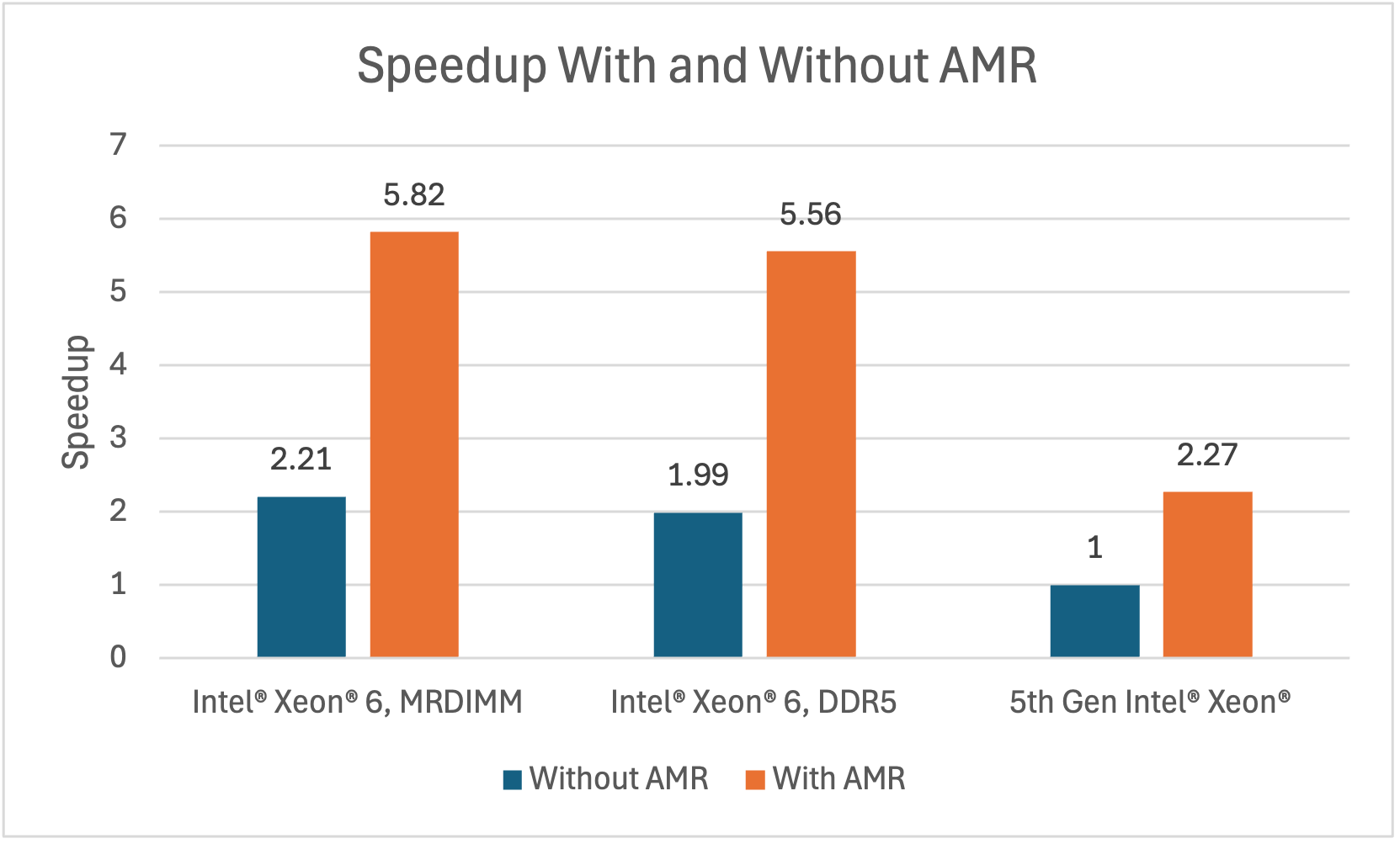
"AMR makes such a big difference in this simulation because it allows us to use a relatively coarse mesh in the central core of the flow, which is approximately laminar. Then we can strategically concentrate our mesh in the areas where it is most needed, at the boundary layer separation and the oblique shock fronts," explains Killian Whyte, Research Engineer on the New Applications team at Convergent Science. "In the case with AMR, we are able to obtain a grid resolution across the shocks that is four times finer than in the case without AMR. Achieving a similar resolution across the shocks with no AMR would require 53 million computational cells and would consume over 20 times more RAM."
AMR provides significant benefits far beyond aerospace applications, whether you're studying flame propagation in an internal combustion engine, thermal runaway in battery packs, or breaking wave effects on offshore wind turbines. Being able to capture the complex multi-physics interactions in your simulation without breaking the computational bank is key to obtaining meaningful insights into your application and designing better technologies.
The Real-World Impact
What do these results mean for a CFD engineer? Making improvements to existing products or developing novel technologies requires extensive exploration of different design options. CFD already provides a substantial advantage by allowing engineers to virtually test and optimize designs before building costly prototypes. Being able to slash runtimes means engineers can further accelerate their design cycles to get new and improved products on the market faster. It also means that engineers can investigate a greater number of design candidates, enabling more effective optimization studies that result in better final products. All of these benefits can be realized simply by running CFD simulations on state-of-the-art hardware.
"The current HPC landscape is becoming increasingly heterogeneous, but modern CPUs continue to be a competitive platform for many scientific computing workloads as they offer strong performance and broad accessibility," says Sidarth Narayanan, Research Engineer on the HPC team at Convergent Science.
Yantao Zhang, Software Technical Consulting Engineer in Intel's Data Center Software Group, who collaborated closely with Convergent Science engineers on this study, adds, "It is exciting to see Intel's continued generation-to-generation CPU performance improvements providing significant value to Convergent Science. These improvements enable CONVERGE users to achieve faster simulations without requiring major changes to established workflows."
Combining the speed of modern CPUs with CONVERGE's advanced modeling capabilities gives engineers the best of both worlds—highly accurate results at a fraction of the runtime. This study showcases the great strides in computing technology that are paving the way for faster simulations, better engineering, and unprecedented innovation.
Find out how you can speed up your simulations—contact us today!
Notices and Disclaimers
- Performance varies by use, configuration, and other factors.
- Performance results are based on testing as of the dates shown in configurations and may not reflect all publicly available updates.
- Your costs and results may vary.
- © Intel Corporation. Intel, the Intel logo, and other Intel marks are trademarks of Intel Corporation or its subsidiaries. Other names and brands may be claimed as the property of others.