

A few years ago, my dad and I took an amazing road trip through West Virginia that was full of remarkably diverse experiences. We crossed the country's longest steel arch bridge and laid our eyes on the whitewater river far below it. We rode a steam train up a mountain from a small ex-company town. We even got to tour Green Bank Observatory, home to a radio telescope so large it's visible for miles, stark white against blue-green hills.
Amid all this beauty, though, many rural areas in West Virginia struggle. More than 250,000 people in the state live without treated water;1 instead, these residents rely on wells that draw from fragile underground aquifers.
Because of these vulnerable water sources, it is important to take precautions when designing and building infrastructure in such areas. For example, pipelines carrying particle-laden flows can be vulnerable to erosion in gate valves and elbows. Mitigating this phenomenon can help prevent wall thinning, reducing the risk of pipe failure and water contamination. CONVERGE allows you to model erosion and design more resilient pipelines through features such as its pressure-based PISO solver, Lagrangian parcel modeling capabilities, porous media models, and morph motion feature for real-time geometry deformation.
An Elbow Erosion Case Study
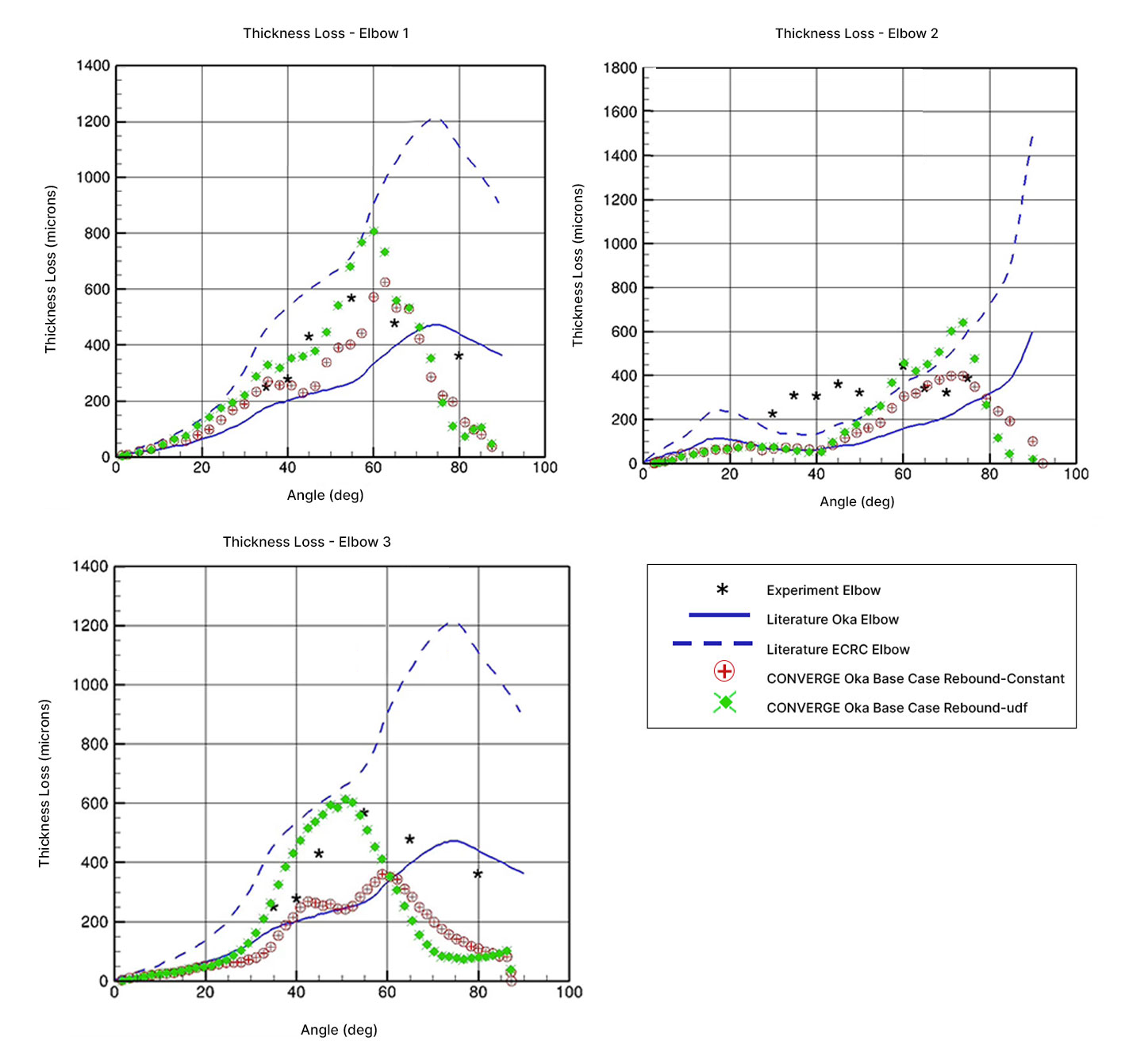
Convergent Science engineers simulated pipeline erosion in CONVERGE based on a benchmark case from Praveen et al. (2014)2 consisting of a 50.8 mm (2 in) erosion test loop of three elbows with an air flow rate of 32 m/s and 28 micron sand particles with a 0.0025 volume percentage concentration. The team used a two-stage approach (visualized in Figure 1) to create the simulation, due to its high efficiency.
Stage One
In Stage One, the team used CONVERGE's Under-Relaxation Steady (URS) solver, in conjunction with a realizable k-ε turbulence model, to run steady-state simulations of air flow through the pipe elbows without sand particles. This allowed the team to find the flow field and fix it for use in Stage Two. Rather than using time marching to reach steady state, as a pseudo-transient solver does, the URS solver uses under-relaxation in place of the transient term to reduce runtime. The realizable k-ε model the team used to simulate turbulence is a type of Reynolds-Averaged Navier-Stokes (RANS) model, meaning it averages fluid equations over time to account for all turbulent flow. The research team also chose to implement an inlaid mesh to ensure flow velocity was accurate, which is crucial for erosion simulations.
Stage Two
In Stage Two, the team added sand particles and erosion modeling to the simulation, using the fixed flow field from Stage One. They modeled the particles using the Lagrangian parcel modeling approach, which tracks parcels of similar particles as they move through the flow field, measuring their trajectories separately. To create the baseline case, the team used a mass per parcel of 3x10⁻⁹ kg, along with restitution coefficients 0.3 (Normal) and 0.7 (Tangential). They also employed the Oka erosion model, which is well-suited for simulating erosion across a wide range of materials.3
Sensitivity Analysis and Results
After developing the baseline case, the team conducted sensitivity analyses for several different variables. For example, they tested a variety of erosion models against the Oka baseline, including Zhang, Arabnejad, and generalized E/CRC. The models displayed similar trends.
They also experimented with different restitution coefficients, which control the rebound velocity when a solid particle impinges on a pipeline wall. In CONVERGE, these coefficients are assumed to be constants. But it is also possible to determine the restitution coefficients based on individual contact angles, using an empirical polynomial function (implemented in CONVERGE as a user-defined function (UDF)). As you can see in Figure 2, CONVERGE's predicted erosion rate aligns well with experimental data for all three elbows in the baseline case, particularly for the polynomial restitution coefficients.
Conclusion
As illustrated in the elbow erosion case study, CFD is a powerful tool that can help you predict erosion in many machinery and pipeline applications, and CONVERGE CFD software offers an array of features to help you get the most out of your simulations. CONVERGE's solid parcel modeling feature allows you to capture highly accurate particle behavior, and its erosion and turbulence models ensure your simulations closely match their real-world counterparts.
By simulating erosion with CFD, we can design more resistant pipelines and machinery, increasing the lifespan of our equipment and protecting quality of life for the people who live alongside it.
References
[1] Hanson, T., "Why thousands of people in rural West Virginia lack reliable drinking water," https://www.cbsnews.com/news/thousands-of-people-rural-west-virginia-lack-reliable-drinking-water/, accessed on Jul 30, 2026.
[2] Kumar, P., Smith, B., Vedapuri, D., Subramani, H., Rhyne, L., "Sand Fines Erosion in Gas Pipelines – Experiments and CFD Modeling," CORROSION 2014, 1-12, 2014. DOI: 10.5006/C2014-3964
[3] Liu, E., Huang, S., Tian, D.-C., Shi, L.-M., Peng, S.-B., Zheng, H., "Experimental and Numerical Simulation Study on the Erosion Behavior of the Elbow of Gathering Pipeline in Shale Gas Field," Petroleum Science, 21(2), 1257-1274, 2024. DOI: 10.1016/j.petsci.2023.08.034