
Blog
Published
Enabling the Hydrogen Ecosystem With CONVERGE

Author: Yogiraj Deshpande
Sr. Research Engineer
Fossil fuels are remarkably convenient and stable at room temperature. Hydrogen, on the other hand, is not. Hydrogen burns cleanly and carries more energy per kilogram than any other fuel, but it's difficult to store and move. Being the lightest element, hydrogen takes up a lot of space as a gas, so storing a useful amount means either compressing it up to 700 bar or cooling it to 20 K and storing it as a liquid. In storage or during transport, it can leak through seals that hold natural gas just fine, embrittle the metals meant to contain it, and ignite with a minimum ignition energy—a tenth of what gasoline needs, barely more than a stray static spark. In practice, it's a chain of hard engineering problems from production to end use, and stress-testing every design iteration physically is slow, expensive, and sometimes hazardous. After all, you can't run a controlled detonation in a warehouse and call it a Tuesday. What you can do is simulate the technologies required for each stage to computationally evaluate their feasibility before they’re built. In the sections that follow, we'll walk through hydrogen's journey stage by stage, from production to end use, and show how CONVERGE helps engineers take on the toughest challenges at every step along the way.
The Journey
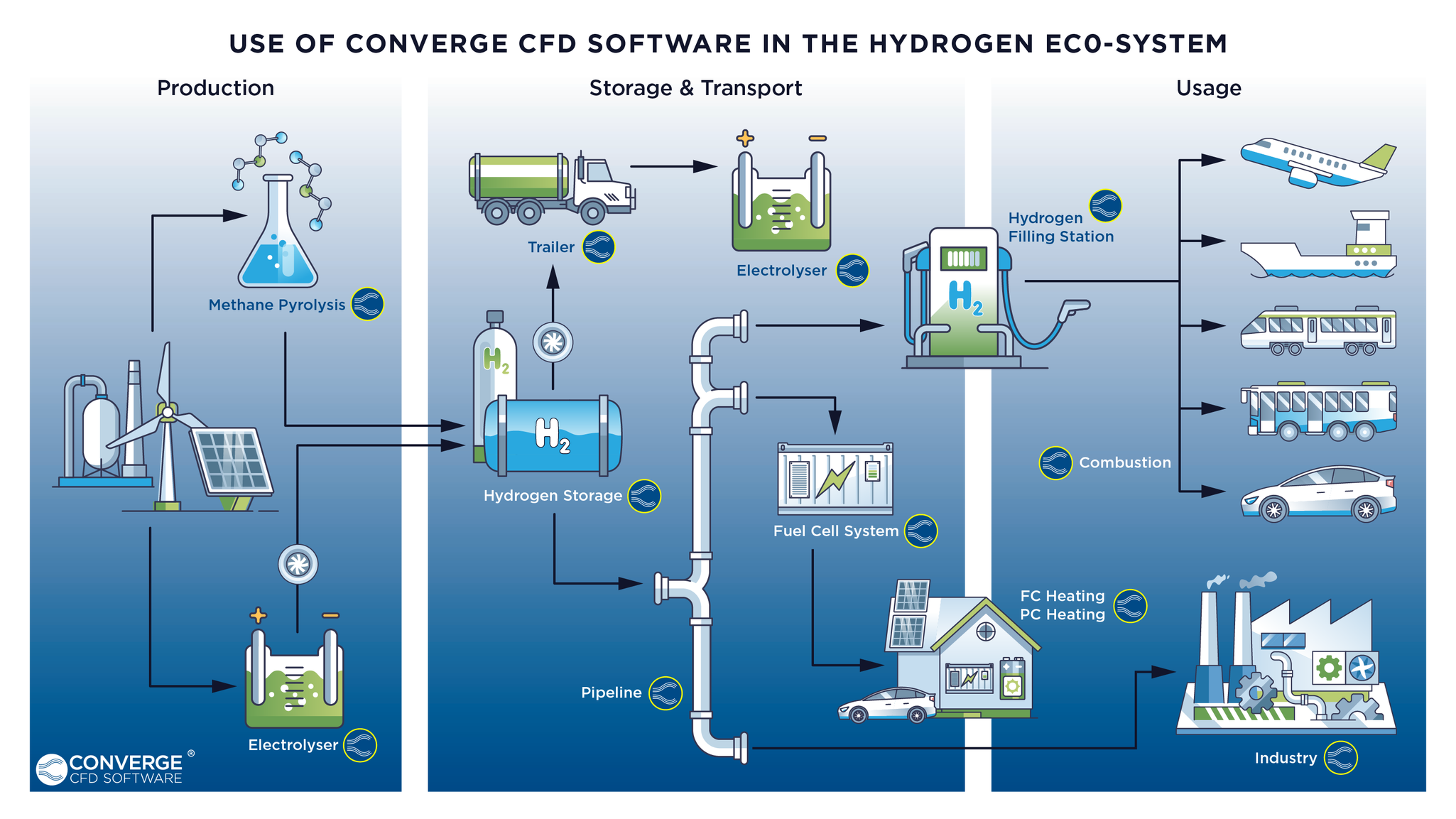
Before we discuss the individual stages in detail, here's the big picture. The first step in the journey is production. Most hydrogen still comes from natural gas reforming, but pyrolysis and electrolysis are scaling up as lower-carbon alternatives. The hydrogen then needs to be stored, either as a compressed gas or as a cryogenically cooled liquid, and transported through pipelines or in trailers to be delivered for its end use in engines, fuel cells, and industrial heating. Safety considerations run through every one of these stages, from small leaks to fires to, in the worst case, detonation. The flowchart in Figure 1 maps this journey, indicating how CONVERGE can be used in each stage.
Production & Storage
Methane pyrolysis is one of the emerging low-carbon routes identified in the IEA Global Hydrogen Review 2025. The process splits natural gas into hydrogen and solid carbon, and its efficiency depends on the reactor flow dynamics, heat transfer, and the reacting chemistry. With CONVERGE, you can solve that coupled problem directly to predict how much of the methane actually turns into hydrogen. You can then try different reactor shapes, wall temperatures, and gas flow rates before determining the prototype to test experimentally. Once produced, hydrogen needs to be stored, either directly for end use or for transport.
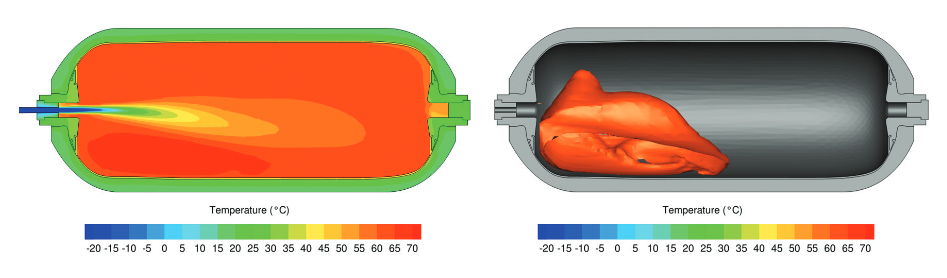
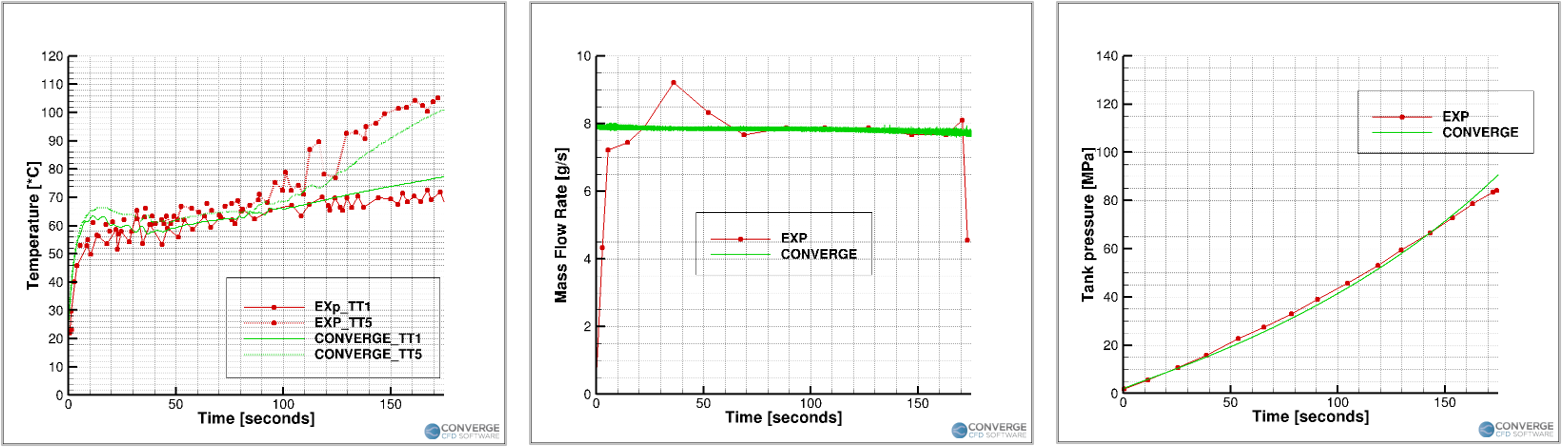
One of the two methods of storing hydrogen is compressing the gas into a high-pressure tank. Compressed gas storage presents a deceptively simple challenge: controlling the gas's temperature rise as the tank fills and pressurizes. Get that temperature rise wrong, and you risk overstressing the tank's materials. With CONVERGE, you can accurately predict the pressure and temperature throughout the entire filling process; at Convergent Science, our engineers have validated the fill cycle in a 36-liter Type IV tank from Hexagon Purus. The mass flow rate, temperature, and pressure matched against experimental measurements for a roughly 200-second fill. (See our white paper Exploring Hydrogen Tank Filling Dynamics for the full study.)
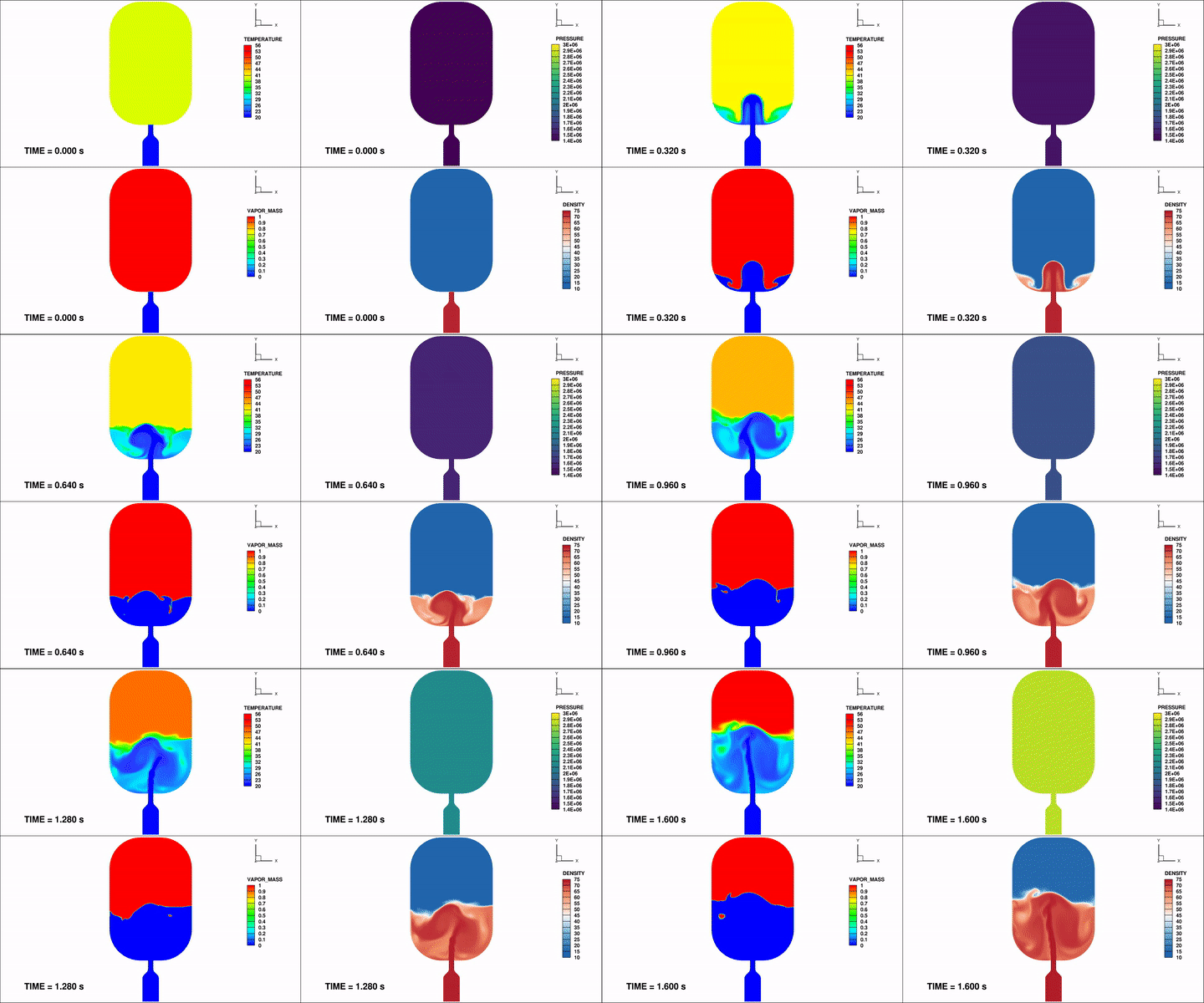
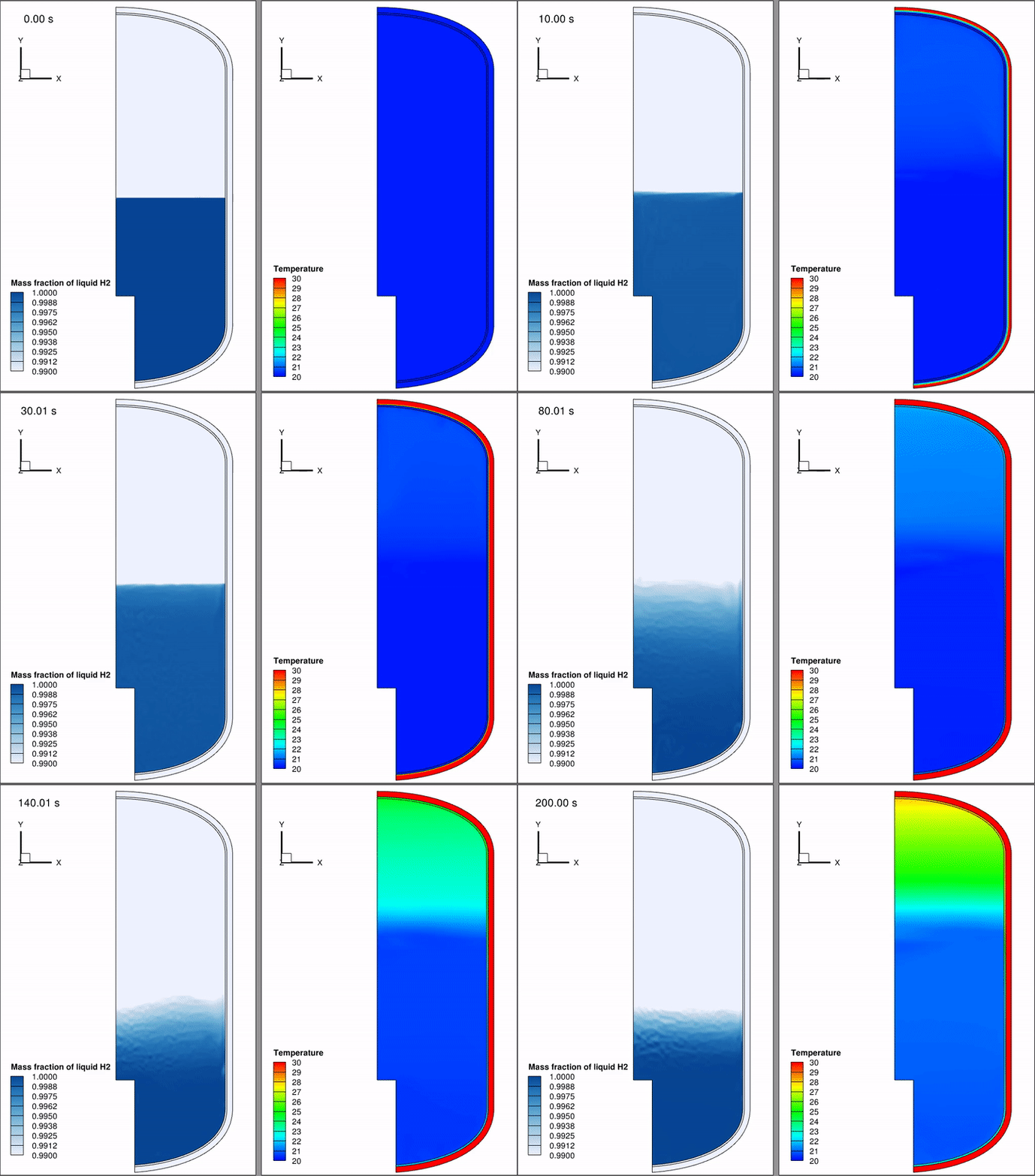
The other method of storing hydrogen is by cryogenically cooling it to the liquid phase, and that’s a different beast entirely. Inside the tank, liquid sits at roughly 20 K with its own vapor above it, and the two are constantly trading heat and mass. Heat leaking in through the insulation boils liquid into vapor and drives the pressure up. On the other hand, vapor meeting a cold surface condenses and pulls the pressure back down, and any change in liquid level compresses or expands the vapor space. The tank pressure is the sum of these effects at a given moment, which explains why the pressure can climb or collapse over the course of a fill. It’s no wonder that simulating this process is not an easy task!. The solver has to track a moving liquid-vapor interface while both phases exchange mass and heat. As complicated as the physics sounds, the mathematics to predict the interaction is far more complicated. Small errors in interface position can compound into large errors in pressure prediction. CONVERGE can handle this challenge with its Eulerian multi-phase solver, which captures liquid-vapor phase change in real time.
Insulated tanks slow heat ingress from the outside environment but do not eliminate it completely, and any heat that reaches the liquid hydrogen boils some of it off. This boil-off causes the pressure to rise inside the tank. With CONVERGE's conjugate heat transfer modeling, you can predict boil-off, capture the heat creeping through multiple layers of solid insulation, and test different insulation materials and tank configurations.
Transport & Safety
Hydrogen in transit is a multi-scale fluid dynamics problem. Because the volumetric energy density of hydrogen is far lower than that of natural gas, pipelines must operate at higher velocities or pressures to deliver the same energy. The pressure drop and temperature gradients need to be managed to reduce property variations. And if the pipeline, originally designed for natural gas, is carrying a hydrogen blend, then the flow characteristics, leak detection, and material compatibility need re-evaluation. With CONVERGE, you can simulate blended-gas pipeline flow to evaluate pressure drop, temperature variation, and leak scenarios before any hydrogen enters the pipeline.
Another mode of hydrogen transport is moving liquid hydrogen in trailers. However, vehicle maneuvers induce sloshing, deform the free surface, enhance heat transfer, and accelerate boil‑off-driven pressure rise, affecting the structural integrity of the tank. The use of pumps for hydrogen transport is equally critical. Hydrogen pumps rarely handle a clean single-phase fluid; the incoming flow is often a liquid-vapor mix that shifts dynamically. Compression converts liquid to vapor; expansion converts it back. A pump not designed around these transitions will cavitate, quietly eroding the hardware from the inside. CONVERGE offers a solution: the software captures sloshing behavior and the subsequent impact on boil-off, helping engineers design baffle configurations and tank geometries that minimize these effects. CONVERGE can also simulate the phase transitions inside the pump, tracking vapor mass fraction and enthalpy through a full reciprocating cycle and flagging cavitation risk before the pump is built.
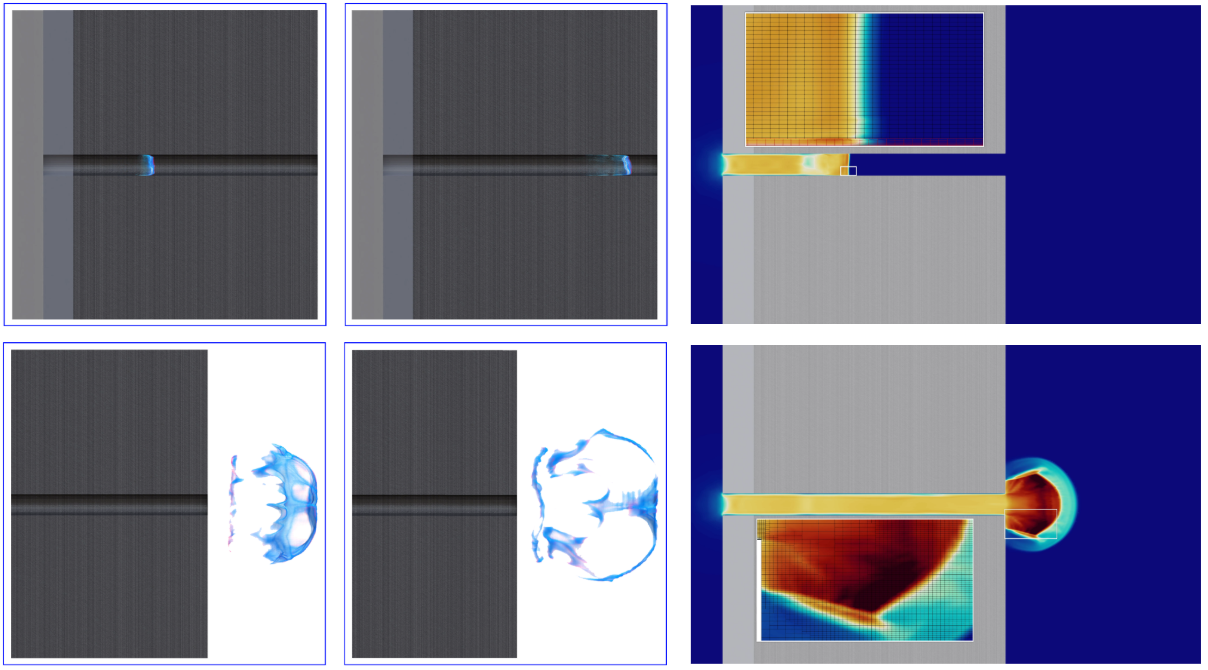
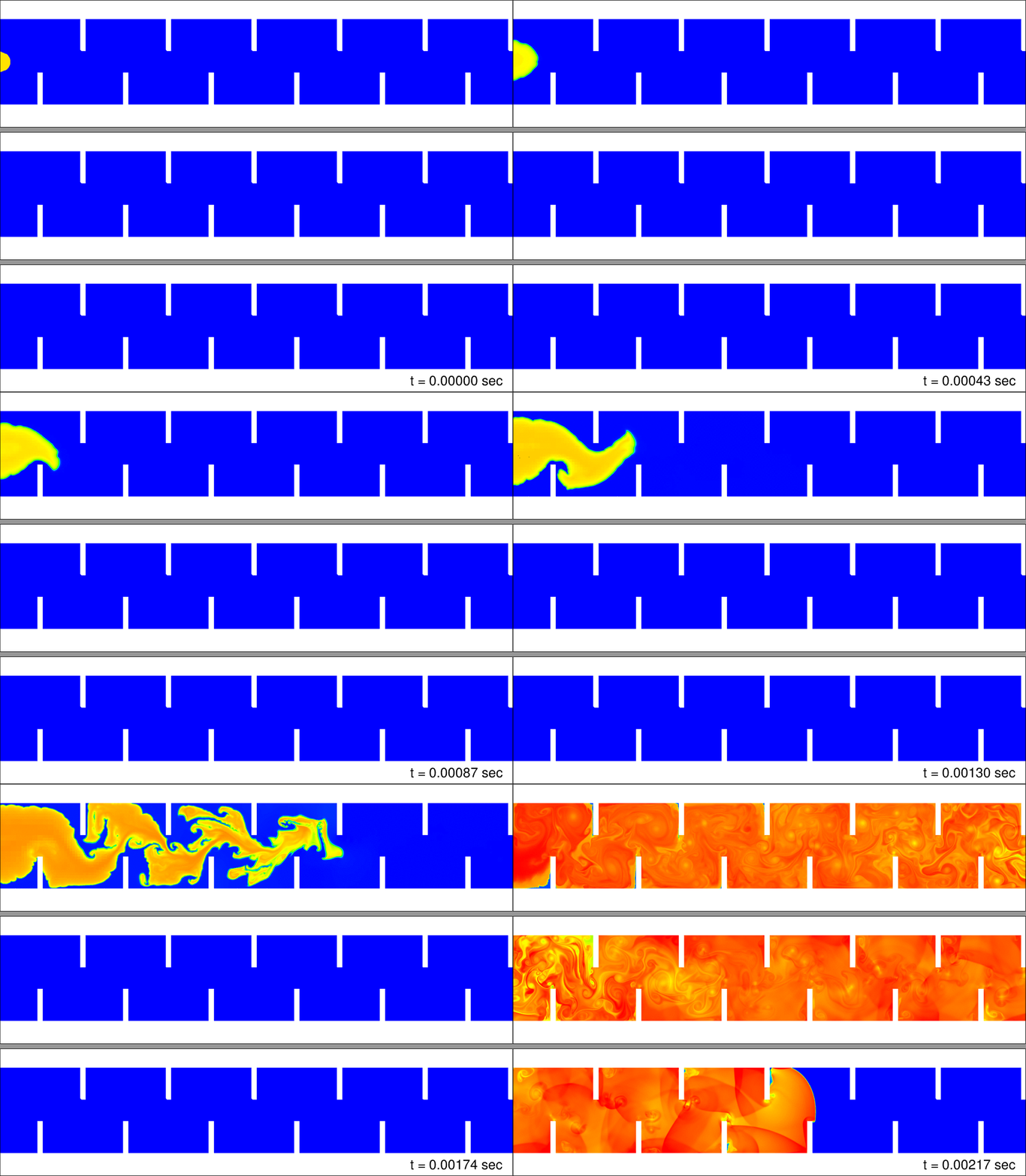
All of this engineering assumes the hydrogen stays contained, but when it doesn't, the margin for error is thin. Hydrogen's flammability range runs from 4% to 75% by volume in air, a window so wide that it makes methane's 5% to 15% range looks tame. A hydrogen leak doesn't have to be large to become serious; it just needs the right concentration and an ignition source. And once ignited, the concerns escalate quickly, from fire and overpressure in a burning tank to, at the extreme end, deflagration-to-detonation transition (DDT). CONVERGE can cover this entire risk spectrum, predicting how hydrogen disperses, how quickly it reaches flammable concentrations in confined spaces, and where the highest-risk zones are. This information is critical information for designing sensor placement and ventilation strategies. You can further simulate self-ignition and run bonfire tests for storage tanks with detailed chemistry to assess overpressure vents and valve behavior without having to run a physical test for every design iteration. If hydrogen escapes through a narrow gap, it can ignite before it ever reaches open air, heated by compression and friction against the walls of the gap itself. At Convergent Science, we have modeled self-ignition near walls due to viscous heating and captured the flame fronts (Figure 5), simulated flame arrestors, and even captured the numerically challenging DDT (Figure 6).
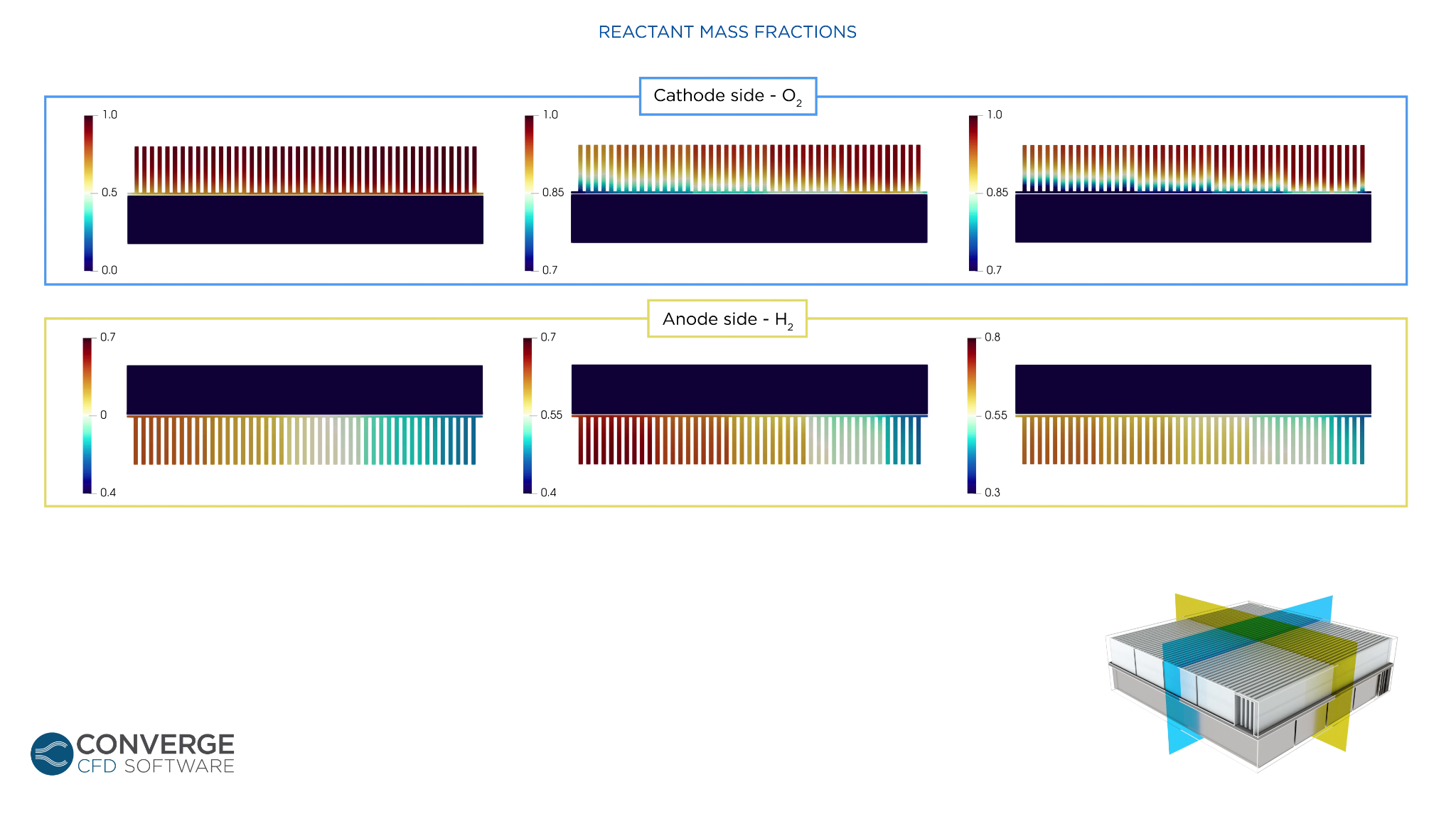
The most anticipated use of hydrogen in the industry is in the transportation sector, where CONVERGE's track record is deep and well-validated: H2 direct-injection, dual-fuel, split-injection strategies, crankcase windage simulations, etc. Apart from these combustion applications, fuel cell systems are another application area where CONVERGE is used to predict cell performance. Beyond vehicles, hydrogen is finding its way into residential and commercial heating, and into industrial applications where electrification isn't practical.
Hydrogen’s path from production to end use is long, unforgiving, and packed with complex physics. Every stage comes with its own distinct problems, and physical testing tends to be expensive, slow, or unsafe. This is why CFD is so valuable here—it lets engineers walk that path virtually first, identifying risks and developing solutions. What makes CONVERGE particularly well suited to the journey is the unique set of features it brings along. Autonomous meshing and Adaptive Mesh Refinement resolve shockwaves, flame fronts, and phase boundaries without high computational cost. Combustion chemistry validated through the Computational Chemistry Consortium keeps ignition and flame behavior accurate across hydrogen's wide flammability range. Fluid-structure interaction and conjugate heat transfer modeling capture the structural and thermal coupling that storage and safety analyses depend on, and the Eulerian multi-phase solver tracks liquid-vapor phase change in cryogenic tanks and pumps alike. Different stages, different physics, one framework!
Contact Us Today
Learn more about how CONVERGE helps you quickly and accurately solve your CFD problems.