Benefits
Events
Products & Programs


Shengbai Xie, Principal Research Engineer–Applications
Convergent Science
Jasim Sadique, Principal Research Engineer–Development
Convergent Science
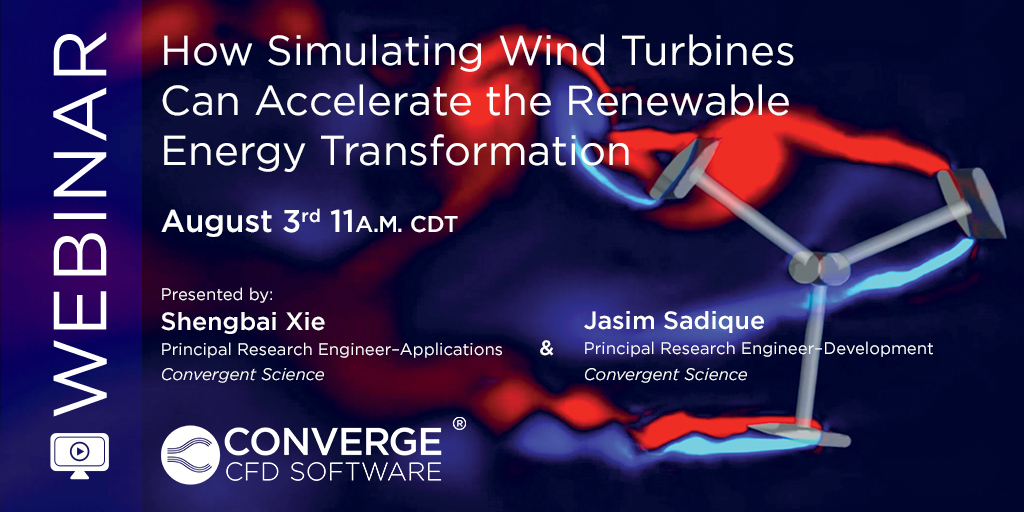
With demand for renewable energy skyrocketing, designing durable wind turbines optimized for maximum power output is essential. Computational fluid dynamics (CFD) enables engineers to virtually assess key design parameters, such as power output under various conditions, wind and wave loads, and downstream wake effects on wind farms. In this webinar, we’ll discuss the tools CONVERGE CFD software offers for simulating both onshore and offshore wind turbines. CONVERGE’s fully autonomous meshing easily accommodates complex environmental terrain as well as rotating turbine blades. To speed up wind turbine simulations, CONVERGE includes simplified models that allow you to capture essential flow structures without needing to resolve the 3D geometry. In addition, CONVERGE features robust fluid-structure interaction modeling, wave generation, and a mooring cable model for accurately simulating offshore wind turbines. We’ll demonstrate the efficacy of these modeling approaches on a variety of cases, including individual onshore wind turbines, wind farms, and floating offshore wind turbines.


