
Blog
Modeling Elbow Erosion in CONVERGE
Published
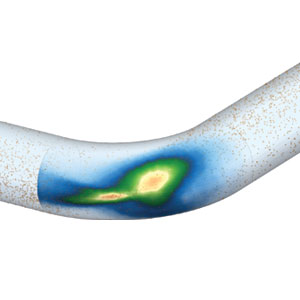
A few years ago, my dad and I took an amazing road trip through West Virginia that was full of remarkably diverse experiences. We crossed the country's longest steel arch bridge and laid our eyes on the whitewater river far below it. We rode a steam train up a mountain from a small ex-company...
Enabling Faster Innovation With Intel's Latest Generation of CPUs
Published
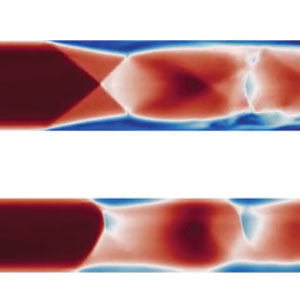
Every computational fluid dynamics (CFD) engineer is familiar with the pressure to get simulation results as quickly as possible, whether you're rushing to get a new product to market, frantically trying to diagnose a system failure in the field, or simply trying to finish your Ph.D. in a reasonable...
Accelerating Automotive Innovation: How GPU-Based Simulations Are Driving Smarter Catalyst Design
Published
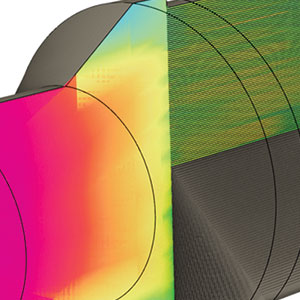
Exhaust aftertreatment systems are a key safeguard to help keep pollutants generated by vehicle engines from being released into the environment. As such, our aim is for aftertreatment systems to be as efficient and effective as possible. When you're trying to maximize the efficacy of a system,...
Intelligent Engine Optimization Using Machine Learning and CFD
Published
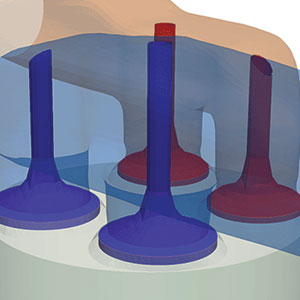
After more than a hundred years, millions of vehicles powered, and billions of kilometers traveled, the diesel engine continues to be a workhorse of the automotive world, especially in high torque applications. However, with tightening emissions regulations and an increasing demand for fuel...
Effects of the CREST Slip-Wall Model and Higher-Order Continuum Momentum Corrections on Local Non-Equilibrium Flow

Published
As aerospace engineering advances, researchers continue to explore flight at higher speeds and over greater distances than ever before. These developments require new technologies and innovative strategies for designing and testing advanced vehicles. Consequently, high-fidelity numerical...
From Uncertainty to Confidence: Evaluating Flare Performance Using CONVERGE
Published
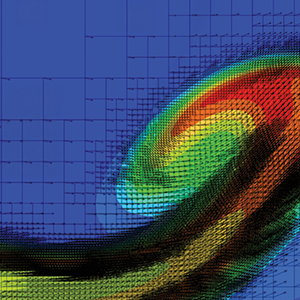
If you've ever driven past an oil and gas facility, you've probably seen those large flames burning in the distance. Those are flares, and they're doing something important: industrial facilities use them to burn excess natural gas that cannot be used economically. This process prevents the...
Spiraling Toward Cleaner Combustion: A CFD Analysis of Swiss-Roll Combustors
Published
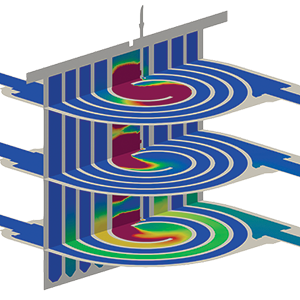
Junji Ito's horror classic, Uzumaki, emphasizes how few shapes are as hypnotic—or as unsettling—as the spiral. But beyond the eerie allure, this simple shape appears everywhere in nature, from snail shells and whirlpools to galaxies and hurricanes. In engineering, the spiral offers an interesting...
Leveraging Custom Panels in CONVERGE for Workflow Automation
Published
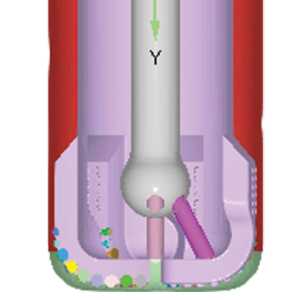
Picture this: it's Friday afternoon, and you're hunched over your workstation trying to set up what feels like the 100th variation of a similar geometry, clicking through the same menus, applying the same boundary conditions, and configuring the same solver settings you have used countless times...
From CAD to Simulation-Ready Models: CAD Capabilities in CONVERGE Studio
Published
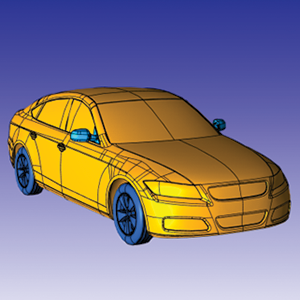
With its truly autonomous meshing capabilities CONVERGE automates the most time-consuming grid generation process for you. It not only simplifies your computational fluid dynamics (CFD) simulation workflow but also accelerates it. However, in CFD, problems rarely come with straightforward solutions....
Engineering at the Edge: How New CONVERGE Features are Powering the Next Generation of Fuel Cells
Published
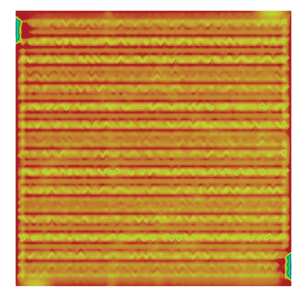
Although fuel cells have recently gained prominence in today's energy discourse, their conceptual origin dates back to the 19th century. In 1842, British scientist William Grove invented the first fuel cell, naming it a "gas battery." For nearly a century, this curious invention would sit quietly in...